
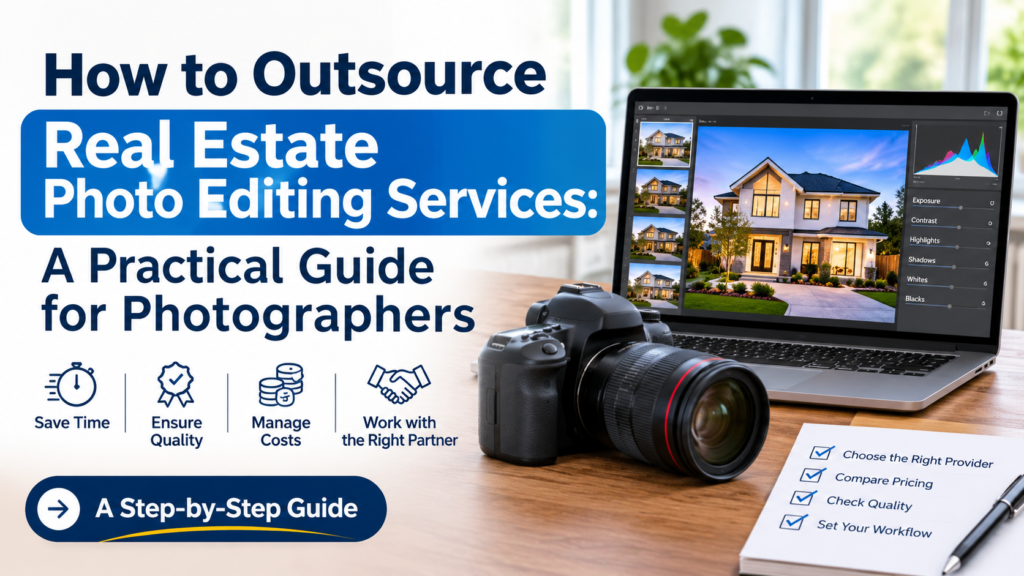
How to Outsource Real Estate Photo Editing Services: A Practical Guide for Photographers
Outsourcing real estate photo editing services can help professional photographers manage larger workloads, maintain consistent image quality and deliver property photographs on schedule without handling every editing task themselves.
The key is choosing an editing partner that understands architectural photography, HDR blending, window exposure correction, perspective alignment and your preferred visual style. Before outsourcing an entire property gallery, evaluate the provider using sample images, a clear editing brief, agreed turnaround times and a defined quality-control process.
This guide explains how to outsource real estate photo editing, what to look for in an editing company, how to compare pricing and how to establish a reliable post-production workflow.
1. Understand Which Real Estate Photo Editing Tasks to Outsource
Before approaching an editing company, identify the post-production tasks consuming the most time in your photography business.
Different properties and shooting conditions require different editing techniques. A provider should understand these requirements rather than applying the same adjustments to every image.
Here are the most common real estate photo editing services to consider.
HDR Real Estate Photo Editing
Interior photographs frequently contain bright windows, dark corners and mixed lighting. HDR editing combines multiple exposures to create a balanced photograph with visible interior and exterior details.
Look for an editor who can:
- Blend multiple bracketed exposures naturally.
- Preserve details in bright windows.
- Balance shadows without making interiors look artificial.
- Maintain realistic colours and contrast.
- Avoid excessive HDR effects and visible halos.
Window Masking and Exposure Blending
Windows can be particularly challenging when photographing interiors during daylight.
Professional window masking helps balance the brightness inside a room with the exterior view. The objective is to retain visible outdoor details without creating unnatural edges or dark outlines around window frames.
Perspective and Lens Correction
Wide-angle photography can make walls, doors and windows appear tilted.
Perspective correction helps align vertical and horizontal architectural lines while preserving realistic room proportions.
Avoid excessive correction that stretches furniture, compresses ceilings or makes rooms appear larger than they actually are.
Day-to-Dusk Photo Editing
Day-to-dusk conversion transforms daytime exterior photographs into evening-style marketing images.
This service can involve:
- Creating a realistic sunset sky.
- Adding natural-looking interior window illumination.
- Enhancing exterior lighting.
- Balancing reflections and shadows.
- Maintaining consistency between the property and the edited surroundings.
Virtual Staging and Object Removal
Virtual staging can help prospective buyers visualize how an unfurnished room might look with furniture.
Object removal can also help eliminate temporary distractions, such as cables, bins and personal belongings, where permitted.
These services should be handled carefully. Material alterations must be disclosed where required by the relevant MLS or property advertising rules.
2. Choose an Editing Company With Relevant Real Estate Experience
Not every photo editing company specializes in property photography.
A provider experienced in product photography or portrait retouching may not automatically understand the technical requirements of architectural images.
When comparing real estate photo editing outsourcing companies, examine the following factors.
Review Before-and-After Samples
Ask for examples of actual real estate editing work.
Compare original and finished photographs to assess:
- Window exposure and HDR blending.
- White balance and colour consistency.
- Straight vertical lines.
- Natural-looking shadows.
- Realistic sky replacements.
- Preservation of architectural details.
Do not judge an editor solely by one attractive photograph. Request examples of interiors, exteriors and challenging lighting conditions.
Check the Editing Workflow
Ask whether your photographs are processed manually, automatically or through a combination of editing methods.
For complex interior images, understand how the provider handles exposure blending, window masking, colour correction and perspective adjustments.
The editing process should be appropriate for the image rather than relying on a generic preset.
Evaluate Quality Control
Find out who checks the completed photographs before delivery.
A dependable workflow should include a review of:
- Exposure and colour accuracy.
- Architectural alignment.
- Window details.
- Image sharpness.
- Unwanted editing artefacts.
- Export specifications.
Also clarify how corrections are requested and whether revisions are included in the quoted price.
3. Compare Real Estate Photo Editing Prices Carefully
Price is an important consideration when outsourcing property photography post-production. However, the cheapest quote is not necessarily the most economical choice.
Different providers may include different editing tasks in their per-image prices.
For example, basic exposure correction is not the same as manually blending several bracketed exposures or creating a detailed twilight conversion.
When comparing quotations, consider these factors:
| Pricing factor | What to check |
|---|---|
| Editing complexity | Basic correction, HDR blending or premium retouching |
| Image volume | Per-image pricing and bulk discounts |
| Delivery speed | Standard and urgent turnaround |
| Revisions | Included corrections and additional charges |
| Output requirements | Resolution, file format and resizing |
| Special services | Virtual staging, object removal and twilight editing |
Understand Per-Image Pricing
Per-image pricing makes it easier to estimate post-production expenses for individual listings.
For example, if a photographer sends 200 images for editing, the total cost will depend on the editing package and any additional services required.
Photo Editing Services Company publishes the following starting package rates on its dedicated real estate service page:
- Basic Enhancement: $0.40 per image.
- Standard HDR: $1.00 per image.
- Premium Custom Editing: $2.00 per image.
These are published starting package rates, not a guaranteed quotation for every project. Confirm the current price and exact scope before ordering.
For studios handling larger volumes, ask whether custom pricing or monthly arrangements are available.
4. Send a Test Batch Before Outsourcing Large Projects
One of the most useful ways to evaluate an editing partner is to start with a small sample batch.
Rather than immediately transferring hundreds of property photographs, select a few representative images.
Your sample batch should ideally include:
- A bright interior with large windows.
- A dark room with mixed lighting.
- An exterior photograph requiring colour correction.
- An image with noticeable perspective distortion.
- A photograph requiring more detailed retouching, if applicable.
Evaluate the results both individually and as a complete gallery.
Check whether the editor follows your instructions, maintains consistent colours and preserves the original property’s appearance.
Create a Clear Editing Brief
A written editing brief reduces misunderstandings and repeated revisions.
Include:
- Preferred exposure and brightness.
- White balance and colour preferences.
- HDR blending requirements.
- Window masking instructions.
- Perspective correction preferences.
- Sky replacement requirements, if applicable.
- Object removal instructions.
- Final image dimensions and file format.
- Delivery deadline.
If you already have an established editing style, provide reference photographs showing the expected results.
A good provider should be willing to clarify instructions before processing the complete assignment.
5. Establish a Reliable Photo Delivery Workflow
A well-organized workflow helps prevent missing files, incorrect edits and unnecessary delays.
A typical outsourcing process looks like this:
Step 1: Organize Your Original Photographs
Separate photographs into folders based on property, shoot date or project number.
Keep bracketed exposures together and use clear filenames.
Step 2: Upload Your Images
Share the original files through an agreed transfer method, such as Dropbox, Google Drive, WeTransfer or an FTP connection.
Avoid repeatedly sending compressed images through messaging applications when full-resolution files are required.
Step 3: Provide Editing Instructions
Include the editing brief, reference photographs and any special requirements.
Identify priority images and communicate the final delivery deadline with its time zone.
Step 4: Review the Edited Photographs
Check the first delivery against your approved references.
Review the complete gallery for consistency, not just individual images.
Step 5: Request Corrections and Approve Delivery
Provide specific feedback where corrections are required.
Once the photographs meet your agreed requirements, download and archive the final files alongside the original photographs.
This process creates a repeatable system that can support recurring property photography projects.
6. Check Turnaround Time and Scalability
A provider may produce excellent photographs but still be unsuitable if it cannot handle your delivery schedule.
Ask the following questions before committing to recurring work:
- What is the standard turnaround time?
- When does the delivery clock begin?
- Can the team handle larger batches?
- Are urgent orders available?
- What happens during seasonal workload increases?
- Can the provider maintain your preferred editing style across multiple projects?
A clear service-level agreement should define the expected delivery window, revision process, communication arrangements and responsibilities.
For growing photography studios, scalability matters just as much as the initial price.
The right outsourcing arrangement should accommodate changes in workload without compromising the agreed quality standards.
7. Protect Property Accuracy and Client Confidentiality
Real estate photographs are marketing materials, but they must still represent the actual property accurately.
Before approving edited photographs, establish clear boundaries between ordinary photographic correction and material alteration.
Generally, exposure balancing, white balance correction, sharpening and perspective adjustments can improve image presentation without changing the underlying property.
However, adding furniture through virtual staging, removing permanent features or changing structural details can raise disclosure and compliance issues.
Rules vary between MLS organizations and jurisdictions. Check the requirements that apply to the listing before publishing altered photographs.
You should also discuss confidentiality and file handling with your editing provider.
Ask about:
- Secure file transfer.
- Access restrictions.
- Storage and retention policies.
- Confidentiality agreements.
- Ownership and permitted use of delivered images.
Do not assume that an advertised security policy automatically replaces the need to establish appropriate contractual terms.
8. Why Consider Photo Editing Services Company?
Photo Editing Services Company provides real estate photo editing and related post-production services for professional photographers, studios, realtors and property marketers.
Its dedicated real estate editing offering covers several common requirements, including:
- HDR real estate photo editing.
- Window masking and exposure balancing.
- Perspective and lens correction.
- Day-to-dusk conversions.
- Virtual staging.
- Drone and aerial photo enhancement.
- 360-degree panorama stitching.
The company publishes a standard 24-hour turnaround for its real estate editing workflows and offers a three-image sample trial, allowing prospective customers to evaluate the results before placing an order.
Its published workflow includes image upload, editing, quality control and delivery through file-transfer options.
For photographers who need recurring post-production support, the company also describes dedicated editing arrangements and custom pricing for higher-volume projects.
The best way to assess whether its service matches your workflow is to submit representative property photographs and communicate your specific requirements.
Explore the service: Real Estate Photo Editing Services
Frequently Asked Questions
1. How do I outsource real estate photo editing services?
Start by identifying the editing tasks you want to outsource. Shortlist providers with relevant real estate photography experience, review their portfolios, submit a sample batch and agree on pricing, editing instructions, delivery times and revision arrangements.
2. How much does real estate photo editing cost?
The price depends on editing complexity, image volume, turnaround time and additional requirements. Photo Editing Services Company publishes starting rates of $0.40 for Basic Enhancement, $1.00 for Standard HDR and $2.00 for Premium Custom Editing per image on its real estate service page.
3. How long does outsourced real estate photo editing take?
Turnaround varies by provider, image volume and editing complexity. Photo Editing Services Company publishes a standard 24-hour turnaround for its real estate editing workflows. Confirm the delivery schedule for your specific project before ordering.
4. Can an editing company match my existing photography style?
Yes, a capable editing provider can use reference photographs and written instructions to establish your preferred visual style. Submit approved examples and review a test batch before starting recurring work.
5. Is outsourcing real estate photo editing suitable for small photography studios?
Yes. Small studios can outsource selected editing tasks or individual projects instead of maintaining a dedicated in-house editing team. The decision depends on workload, budget, quality requirements and the time saved.
Final Thoughts: Build a Better Real Estate Photography Workflow
Outsourcing real estate photo editing can help photographers spend more time capturing properties, communicating with clients and developing their businesses.
The most important decision is finding an editing partner that understands real estate photography, follows your instructions, maintains visual consistency and delivers within an agreed schedule.
Start with a small sample batch, establish your editing preferences and compare the results against your business requirements before committing to larger projects.
Ready to simplify your real estate photo editing workflow?
Explore Photo Editing Services Company’s real estate photo editing services and request three free sample edits to evaluate the service using your own property photographs.
