
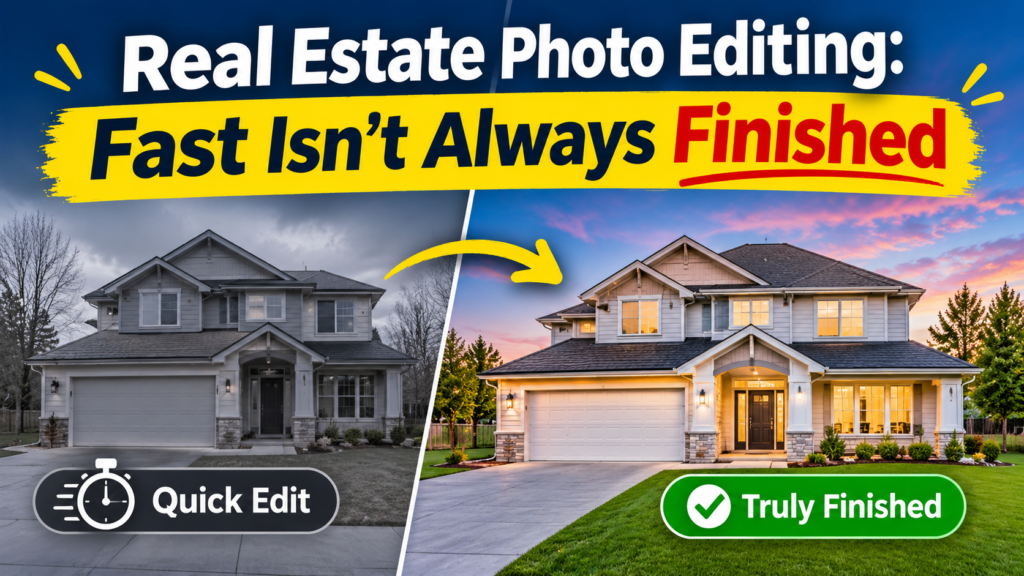
Real Estate Photo Editing: Fast Isn’t Always Finished
Your edited photographs arrive on time. Your property listing still cannot go live.
The kitchen images need another colour adjustment. Two bedroom photographs are missing. The agent wants a different exterior image. The files are larger than the publishing platform accepts.
The editing deadline was met, but the listing deadline remains at risk.
This is the gap photographers and property marketing teams should examine when comparing real estate photo editing services. Speed matters, but receiving files and receiving an approved, usable image set are different milestones.
Before choosing an editing provider, ask:
“How will this workflow get us from completed shoot to approved listing?”
The answer should cover preparation, editing, review, corrections and final delivery—not just the advertised turnaround.
1. Define What “Delivered” Means Before Booking
A turnaround promise needs a clear starting point and endpoint.
Does processing begin when the first file uploads or when the complete batch and instructions are received? Does delivery mean the initial edit or a final set that has passed your review?
These details become especially important when teams work across time zones.
Confirm:
- When the provider accepts the project.
- Which time zone applies.
- Whether the estimate covers your image quantity and editing tasks.
- What happens when files or instructions are missing.
- Whether weekends and holidays affect the schedule.
- How revisions are handled after the initial delivery.
Photo Editing Services Company advertises standard 24-hour turnaround for basic enhancement and standard HDR work, with rush options available on request. Confirm the schedule for your actual batch before promising a delivery time to your client.
2. Plan Backwards From the Listing Deadline
If the agent needs approved images on Thursday morning, that is the deadline the workflow must support.
Work backwards from it.
Allow time for the final export, any necessary corrections, your review and the initial editing. Then determine when the complete source files must be available.
| Stage | What needs to be complete |
|---|---|
| Client delivery | Approved files organised and accessible |
| Final check | Corrections verified and export requirements checked |
| Revision stage | Specific feedback addressed |
| First review | Complete set checked against the brief |
| Editing | Agreed tasks performed on supplied files |
| Handover | Sources, selections and instructions accepted |
This is a planning framework, not a fixed timetable. Agree on the time needed for each stage with the people responsible.
A first delivery arriving at the same moment as the client deadline leaves no room to resolve an unexpected issue.
3. Decide Who Selects the Final Images
A folder containing every photograph from the shoot can create avoidable uncertainty.
Are editors expected to choose the strongest frames? Should they process every exposure group? Are similar views alternatives or separate deliverables?
Clarify selection responsibility before uploading.
If you select the images, provide a definitive list. If the editing provider handles selection, agree on the criteria and whether that work is included.
For bracketed photography, distinguish source-frame quantity from finished-image quantity. Several exposures may belong to one final photograph.
A useful handover might state:
Deliver 24 final images from the selected exposure groups. Keep the numbered room sequence. The two exterior alternatives are for review; only the approved version belongs in the final delivery folder.
Clear selection instructions reduce the chance of unnecessary work or missing images.
4. Use a Short Brief That Answers Real Editing Questions
“Make it bright and professional” leaves too much to interpretation.
A practical brief should explain the desired appearance and the limits of the changes.
Include:
- Preferred brightness and contrast.
- Treatment of warm finishes.
- Window appearance.
- Perspective correction expectations.
- Permitted object removal.
- Features that must remain unchanged.
- Reference images.
- Required output versions.
For example:
Keep the warm timber flooring and cream cabinetry recognisable. Balance interior brightness across the set. Remove only the photography equipment identified in the notes. Preserve permanent fixtures and visible property condition.
The brief does not need to be long. It needs to answer the decisions the editor will otherwise have to guess.
When discussing real estate photo editing services, send an approved reference alongside your source files so the quotation and workflow reflect your preferred result.
5. Keep Special Requests Separate From Routine Editing
A batch may contain several types of work.
Most images might need standard adjustments, while a few require detailed retouching, virtual staging or a twilight-style conversion. Confirm whether those tasks share the same delivery schedule.
Identify special requests by filename.
| Image group | Information to provide |
|---|---|
| Standard interiors | Reference style and selected exposure groups |
| Exterior images | Agreed treatment and accurate property details to retain |
| Detailed retouching | Marked areas and specific instructions |
| Virtual staging | Furnishing brief, approval process and identification requirements |
| Additional exports | Dimensions, file types and naming requirements |
If necessary, ask whether completed standard images can be delivered before separately scoped creative work. Confirm that partial delivery fits your client’s plan.
Avoid letting one unclear request hold up an otherwise complete batch.
6. Review the Listing as a Set
Individual photographs can look good while the complete listing feels inconsistent.
A wall may appear cream in one view and white in another. The same floor may change from warm brown to grey. Exterior photographs may have noticeably different treatments.
Review related images together.
Start with a contact sheet or gallery showing the whole property. Check consistency and completeness before inspecting individual details.
Then review:
- Window and doorway edges.
- Furniture near the frame boundaries.
- Reflections.
- Light-coloured surfaces.
- Areas that received retouching.
- Any changes specifically requested in the brief.
This two-stage review helps separate set-level issues from image-level corrections.
If you manage several editing categories, Photo Editing Services Company provides a central point for discussing your broader post-production requirements.
7. Appoint One Person to Consolidate Feedback
Conflicting instructions can prolong revisions.
The photographer requests a neutral finish. The agent asks for a warmer room. Another reviewer wants more contrast. The editor receives three separate messages without knowing which takes priority.
Choose one person to gather and approve feedback.
Use a consistent format:
| Filename | Issue | Requested correction |
|---|---|---|
| Kitchen-03 | Cabinets appear too white | Restore the warm ivory tone shown in the reference |
| Bedroom-02 | Image is darker than the adjoining view | Match the agreed brightness while retaining detail |
| Exterior-01 | Wrong delivery version | Supply the approved web-sized export |
Separate corrections to the original brief from new creative requests. Both may be reasonable, but they can affect the schedule differently.
Send one organised feedback document where possible and confirm when the review is complete.
8. Protect Property Accuracy When the Deadline Gets Tight
A deadline can create pressure to accept an image without checking what changed.
Keep accuracy checks in the final review.
Confirm that permanent features remain visible, room proportions have not been materially altered and the surroundings still represent the property.
For substantial alterations or virtual staging, agree on appropriate identification and check the requirements of the intended publishing platform and market.
If source photographs do not contain usable detail, ask the editor to explain the limitation. An alternative frame or reshoot may be preferable to inventing information.
Fast processing should not remove the approval decisions that make the photographs suitable for their intended use.
9. Check the Export Before Calling the Job Finished
File preparation belongs in the brief, not in a last-minute message after editing.
Specify the current requirements of the intended website or listing platform, including dimensions, file type and any size limits.
Confirm whether you need:
- A high-quality master set.
- Web-ready versions.
- Different crops.
- Separate staged and unstaged files.
- Additional formats for print or marketing.
Use clear folders and retain property identifiers in filenames.
A simple delivery structure might contain an approved master folder and an approved web folder. Keep superseded versions elsewhere so they cannot be uploaded accidentally.
Before sending the client link, open it using the intended access permissions and check that all required files are present.
10. Measure Time to Approval, Not Just Time to First Delivery
If you outsource regularly, track the complete workflow for several batches.
Record:
- When complete files were submitted.
- When the project was accepted.
- When the first delivery arrived.
- How long your review took.
- Which corrections were requested.
- When the final batch was approved.
This helps you identify where delays actually occur.
The issue might be incomplete uploads, inconsistent instructions, provider corrections or slow internal approval. Treat the records as evidence for improving the process rather than assuming every delay belongs to one party.
A useful internal measure is:
Total completion time = time from accepted handover to approved final files.
Review that alongside quality and workload. A fast first delivery is valuable when it moves the project closer to completion.
What to Ask Before Your Next Order
Use these questions when discussing a project:
- Does the quoted turnaround apply to this quantity and editing scope?
- When does the delivery clock begin?
- Who selects the final images?
- What source files and references are required?
- How are missing files or unclear instructions handled?
- What is the revision process?
- Can special requests have separate delivery dates?
- Which exports are included?
- Who communicates if the schedule changes?
- How should we approve the final batch?
These questions turn a broad speed promise into a workflow you can plan around.
Frequently Asked Questions
What is a reasonable real estate photo editing turnaround time?
It depends on the image quantity, source condition, editing tasks and provider availability. Confirm the timing for your specific batch and allow space for review and corrections.
Does 24-hour delivery include revisions?
Do not assume it does. Ask whether the stated turnaround covers the first delivery and agree separately on correction timing.
Can outsourcing help with multiple property shoots?
It can provide additional editing support, but the handover still needs clear property identifiers, selections and style instructions. Confirm capacity for your expected workload before relying on it.
How can I reduce avoidable delays?
Upload complete files, identify the required outputs, supply approved references and nominate one reviewer. Raise special requests before the project starts.
Should I always choose the fastest editing provider?
Compare speed with consistency, communication and the time needed to obtain an approved final batch. The best fit is the workflow that meets your actual delivery requirements.
Plan Your Next Listing With Photo Editing Services Company
A dependable editing workflow makes the next step clear: what to upload, when to expect the first set, how to request corrections and which files are ready for publication.
Photo Editing Services Company lists HDR editing, retouching, twilight conversion, virtual staging and other property-image services. Share your source material and deadline so the team can confirm the appropriate scope and schedule.
Explore real estate photo editing services and request a sample or quotation for your next property shoot.
For wider editing requirements, visit Photo Editing Services Company.
Set the deadline around approved images—not just an arrival notification.
