
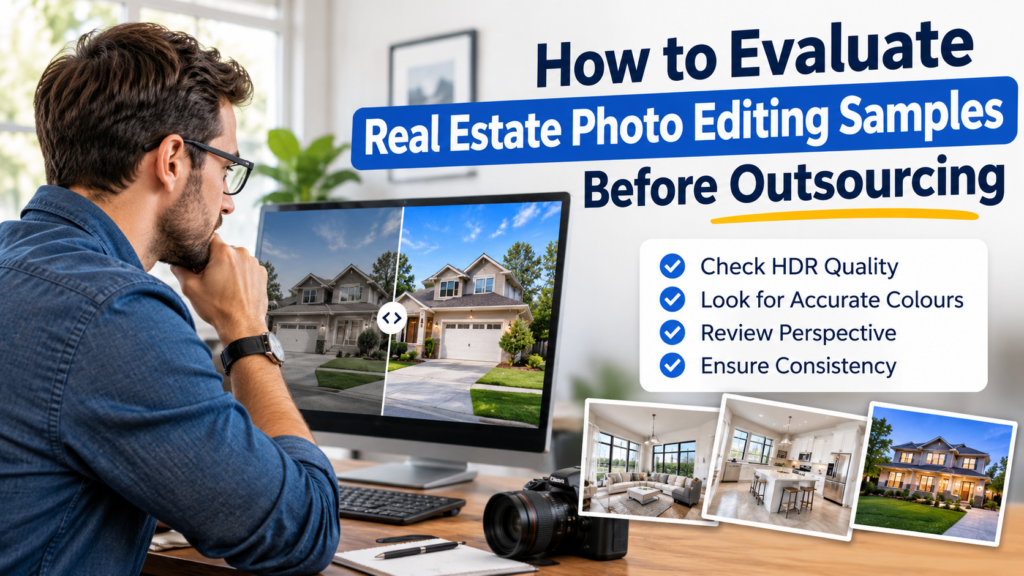
How to Evaluate Real Estate Photo Editing Samples Before Outsourcing
Choosing a real estate photo editing company is not just about finding attractive before-and-after photographs. You need an editing partner who can consistently reproduce your preferred style, handle difficult lighting conditions, preserve architectural accuracy and deliver images within your listing deadlines.
The best way to evaluate a provider is to request sample edits using your own original property photographs. Examine HDR blending, window exposure, colour accuracy, perspective correction and overall consistency before committing to a recurring editing arrangement.
Here is a practical checklist to help real estate photographers, photography studios and property marketing agencies choose the right editing partner.
1. Start With Representative Property Photographs
A provider’s portfolio may contain impressive images, but those photographs do not necessarily demonstrate how the company will handle your particular shooting conditions.
Instead of evaluating an editor using only their best portfolio images, submit a small selection of your own photographs.
Ideally, include:
- A bright interior: Check how the editor handles large windows and strong daylight.
- A dark interior: Evaluate shadow recovery and mixed-lighting correction.
- A kitchen or living room: Look for natural white balance and realistic colour reproduction.
- An exterior photograph: Examine sky replacement, lawn enhancement and perspective correction.
- A challenging architectural image: Check whether walls, doorframes and windows remain properly aligned.
These examples help you evaluate different editing requirements rather than judging the entire service based on one attractive photograph.
2. Check HDR Blending and Window Exposure
HDR blending is one of the most important aspects of professional real estate photo editing.
Interior photographs often contain significant exposure differences. Windows may be much brighter than the surrounding walls, while furniture and corners remain relatively dark.
A good editing result should balance these areas without making the photograph look artificial.
When reviewing HDR samples, check:
- Are bright window details visible?
- Are dark corners sufficiently illuminated?
- Do walls retain their natural colour?
- Are highlights and shadows balanced?
- Are there unnatural halos around window frames?
- Does the image maintain realistic contrast?
Pay particular attention to window masking.
A poor window pull can create dark outlines around window frames or make the outdoor view appear unnaturally pasted into the photograph.
The goal is to show both the interior and exterior clearly while preserving the original lighting character.
3. Examine Colour Accuracy and White Balance
Colour consistency is essential when presenting an entire property gallery.
A living room with warm lighting should not look completely different in colour from the adjoining kitchen simply because the photographs were edited separately.
Look at the following details:
White surfaces: Ceilings, cabinets, walls and countertops should appear reasonably neutral without excessive yellow, orange or blue colour casts.
Wooden surfaces: Flooring, furniture and cabinetry should retain their natural appearance rather than becoming oversaturated.
Artificial lighting: Warm light fixtures should retain a natural glow without turning the entire room yellow.
Exterior colours: Grass, plants, roofs and walls should look realistic rather than artificially enhanced.
Also compare multiple images from the same property. Consistent exposure, contrast and colour grading help create a cohesive listing gallery.
4. Evaluate Perspective and Architectural Accuracy
Real estate photographers frequently use wide-angle lenses to capture complete rooms. However, wide-angle photography can cause walls, doors and vertical structures to appear tilted.
Perspective correction helps restore the appearance of straight architectural lines.
When evaluating sample edits, examine:
- Vertical doorframes.
- Window edges.
- Wall corners.
- Cabinet alignment.
- Ceiling lines.
- Exterior building facades.
However, straightening every line should not come at the expense of realistic proportions.
Excessive correction can stretch furniture, compress ceilings or make a room appear larger than it actually is.
A professional editor should improve the image’s composition while preserving the property’s actual dimensions and structural appearance.
5. Look for Natural Retouching Instead of Excessive Editing
Professional property photographs should look polished without becoming misleading.
Review how the editing company handles:
- Minor distractions and temporary clutter.
- Reflections and glare.
- Patchy lawns.
- Overcast skies.
- Small cosmetic imperfections.
- Furniture and interior presentation.
The important distinction is between improving photographic presentation and materially changing the property.
For example, correcting exposure or removing a temporary cable is different from digitally concealing structural damage or fabricating a view that does not exist.
Virtual staging and other material alterations should be handled transparently, with appropriate disclosure under the applicable property advertising and MLS rules.
Before approving a project, establish which edits are permitted and which require special instructions.
6. Compare the Entire Gallery, Not Just Individual Images
One attractive photograph does not prove that an editing provider can maintain consistency across an entire property listing.
Request several sample edits and compare them together.
Use this checklist:
| Quality factor | What to examine |
|---|---|
| Exposure | Similar brightness across comparable rooms |
| White balance | Consistent colour temperature |
| HDR blending | Natural highlights and shadows |
| Window masking | Clean edges without visible halos |
| Perspective | Straight architectural lines |
| Sharpness | Clear details without excessive processing |
| Retouching | Natural-looking corrections |
| Overall style | Consistency with your approved references |
If possible, compare the finished images against photographs from your existing portfolio.
This is particularly important for studios working with multiple photographers or property marketing agencies managing different client brands.
7. Test the Editing Workflow Before Sending Large Projects
Image quality is only one part of a successful outsourcing arrangement.
You should also evaluate how the company receives files, understands instructions, manages revisions and delivers completed photographs.
Ask these questions:
- Which RAW and image formats do you accept?
- Can I upload photographs through Dropbox, Google Drive or FTP?
- Can you follow my existing editing style?
- Is there a quality-control process before delivery?
- What is the standard turnaround time?
- Are revisions included?
- Can you accommodate higher image volumes?
A clear workflow helps prevent missing photographs, repeated instructions and unnecessary delays.
For recurring projects, create a written editing profile containing your preferred exposure, colour grading, window treatment, contrast, perspective correction and export requirements.
You can also provide five to ten reference photographs alongside their original files to help establish the desired editing style.
8. Compare Pricing Against the Actual Editing Requirements
When comparing photo editing companies, avoid making a decision based solely on the lowest per-image price.
Different packages may include different levels of editing.
For example:
- Basic enhancement may cover exposure, contrast, colour correction and lens alignment.
- Standard HDR editing may include multiple-exposure blending, window pulls and additional exterior corrections.
- Premium editing may involve complex retouching, flash-ambient blending and twilight conversions.
Compare the actual deliverables before evaluating the price.
Photo Editing Services Company publishes the following starting rates for its real estate photo editing services:
| Editing package | Published starting price |
|---|---|
| Basic Enhancement | $0.40 per image |
| Standard HDR | $1.00 per image |
| Premium Custom Editing | $2.00 per image |
The packages are designed for different editing requirements, from straightforward property photographs to more complex architectural and luxury property images.
Custom rates and monthly arrangements are also available for high-volume studios submitting 500 or more images per month.
Confirm the current quotation and package scope before placing an order.
9. Check Turnaround Time, Revisions and Scalability
A photo editing company may produce excellent images but still be unsuitable if it cannot meet your delivery requirements.
Ask the provider to clarify:
- Standard delivery time.
- Availability of urgent orders.
- Maximum daily image capacity.
- Revision arrangements.
- Delivery formats and dimensions.
- Processes for handling seasonal workload increases.
Also establish when the turnaround clock begins. For example, does it start when the files are uploaded or after the editing instructions have been confirmed?
For photography studios handling multiple properties, reliable delivery and consistent quality should be evaluated together.
Photo Editing Services Company publishes a standard 24-hour turnaround for its basic and standard HDR workflows, with a 12-hour rush option available upon request.
Its workflow also includes quality checks and free revisions.
These are useful points to verify against your own project requirements before starting a regular arrangement.
10. Why Consider Photo Editing Services Company?
Photo Editing Services Company provides professional real estate photo editing for photographers, studios, realtors and property marketers.
Its real estate editing capabilities include:
- HDR real estate photo editing.
- Window masking and exposure balancing.
- Perspective and lens distortion correction.
- Day-to-dusk conversions.
- Virtual staging.
- Drone and aerial photo enhancement.
- 360-degree panorama stitching.
- Object removal and property retouching.
The company publishes a monthly processing capacity of more than 50,000 property images and supports workflows involving Dropbox, Google Drive, WeTransfer and FTP.
It also offers a three-image free sample trial.
This gives prospective customers an opportunity to submit representative property photographs and assess the editing results before committing to a larger project.
For photographers and studios looking for an ongoing editing arrangement, custom style profiles and volume-based pricing are additional considerations.
Frequently Asked Questions
1. How many sample images should I send to a real estate photo editing company?
Start with three to five representative photographs covering different lighting and editing conditions. Include interiors, exteriors and challenging images so you can evaluate the provider’s capabilities.
2. What should I check in real estate HDR photo editing samples?
Examine exposure balance, window details, shadow recovery, natural colours and visible HDR artefacts. Pay particular attention to halos around window frames and unnatural colour transitions.
3. Can a photo editing company match my existing editing style?
A capable editing provider can use approved reference photographs and written instructions to establish a consistent editing profile. Share examples of your preferred results and review a sample batch before starting regular projects.
4. How much does professional real estate photo editing cost?
Pricing depends on the editing complexity, number of images, turnaround requirements and additional services. Photo Editing Services Company publishes starting rates of $0.40, $1.00 and $2.00 per image for its Basic, Standard HDR and Premium packages, respectively.
5. How long does real estate photo editing usually take?
Delivery times depend on the provider, image volume and editing requirements. Photo Editing Services Company publishes a standard 24-hour turnaround for its basic and standard HDR workflows. Confirm the delivery schedule for your particular project.
Final Thoughts
Choosing a real estate photo editing company requires more than looking at attractive portfolio images.
You need to evaluate the actual editing quality, consistency across property galleries, communication process, delivery reliability and ability to follow your preferred visual style.
Start with a small sample batch, provide clear editing instructions and compare the finished photographs against your expectations.
If the results meet your quality requirements and the workflow fits your business, you can move forward with greater confidence.
Ready to evaluate your real estate photo editing quality?
Photo Editing Services Company offers three free sample edits so you can assess its work using your own property photographs before placing a larger order.
Request Your 3 Free Real Estate Photo Editing Samples
No payment is required for the sample trial.
