
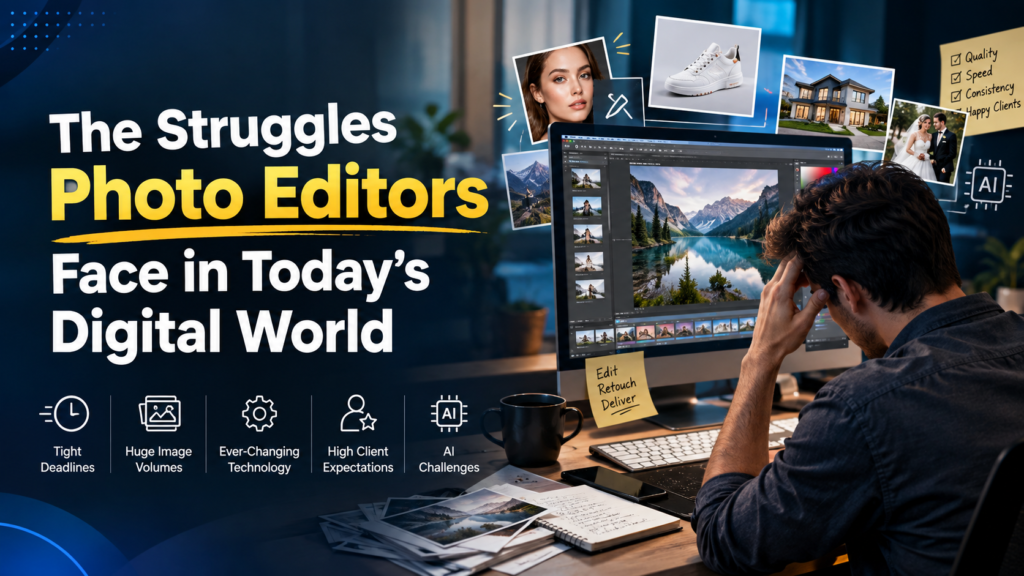
The Struggles Photo Editors Face in Today’s Digital World
Photography has never been more accessible than it is today. Powerful cameras are built into smartphones, mirrorless cameras continue to become more advanced, and social media platforms have created an enormous demand for visually appealing content. Businesses, photographers, real estate professionals, ecommerce brands, advertising agencies, and individuals all depend on high-quality images to communicate their ideas and attract attention.
Yet behind almost every polished photograph is a demanding post-production process.
While viewers may see only a beautiful final image, professional photo editors often spend hours correcting colors, removing distractions, masking complicated objects, retouching skin, restoring damaged photographs, adjusting lighting, creating realistic shadows, and ensuring that every image meets a client’s expectations.
The digital world has made photo editing more powerful, but it has also made the profession significantly more challenging.
Editors today must work faster, maintain extremely high standards, understand constantly changing software and technology, manage huge image volumes, meet tight deadlines, preserve creative consistency, and increasingly determine when artificial intelligence should—and should not—be used.
A 2026 Adobe Research study examining 83,000 real-world image-editing requests found that the best AI editors could fulfill only about one-third of the tested requests according to human evaluations. The research also found that AI can struggle with precise edits, preserving the identity of people and animals, and avoiding unwanted changes.
This demonstrates an important reality: technology can assist photo editors, but professional image editing still requires human judgment, creativity, precision, and attention to detail.
So, what are the biggest struggles photo editors face in today’s digital world?
1. The Growing Demand for Faster Turnaround Times
One of the biggest challenges for professional photo editors is speed.
Clients no longer want to wait weeks to receive their edited images. In many industries, the expectation has shifted toward same-day or next-day delivery.
A wedding photographer may need hundreds or thousands of images edited immediately after an event. A real estate photographer may need property photographs ready before a listing goes live. An ecommerce business may need product images processed before a new product launch.
This creates tremendous pressure on editors.
The challenge is not simply editing faster. Editors must work faster without sacrificing quality.
A rushed editor can easily make mistakes such as:
- Incorrect color correction
- Uneven exposure
- Poor masking
- Jagged edges
- Over-retouched skin
- Unnatural shadows
- Incorrect perspective
- Inconsistent backgrounds
- Lost image details
- Exporting images in the wrong format or resolution
The faster the workflow becomes, the more important quality-control systems become.
Professional editing companies therefore need efficient workflows, experienced editors, standardized processes, and dedicated quality checks to balance speed with accuracy.
2. Handling Huge Volumes of Images
Digital photography has created another major problem: image volume.
Photographers can capture hundreds or thousands of photographs during a single assignment because memory cards and digital storage are relatively inexpensive.
But taking 2,000 photographs is much easier than editing 2,000 photographs.
Imagine a wedding photographer returning from an event with 3,000 RAW images.
Every selected photograph may require:
- Exposure correction
- White balance adjustment
- Color correction
- Cropping
- Straightening
- Skin retouching
- Object removal
- Background correction
- Noise reduction
- Sharpening
- Exporting
Even simple adjustments become a significant workload when multiplied across thousands of files.
The result is a growing post-production backlog.
For independent photographers, this can mean spending evenings and weekends in front of a computer instead of:
- Booking new clients
- Photographing new projects
- Marketing their business
- Meeting customers
- Building their portfolio
- Developing creative concepts
- Spending time with family
This is one of the primary reasons professional photographers increasingly consider outsourcing parts of their editing workflow.
3. The Pressure to Maintain Consistency
Editing one photograph beautifully is one thing.
Editing 500 photographs consistently is something completely different.
Professional clients expect an entire collection to look like it belongs together.
For example, a wedding gallery should not contain one photograph with warm skin tones and another with noticeably cool skin tones. A real estate portfolio should maintain consistent brightness, color, perspective, and visual presentation. Ecommerce product images should look uniform across an entire catalog.
Consistency becomes particularly challenging when:
- Images were captured under different lighting conditions
- Multiple cameras were used
- Photographers changed locations
- Indoor and outdoor images are mixed
- Different lenses were used
- Weather conditions changed
- The client’s editing preferences are highly specific
An editor must therefore understand not only individual images but also the visual language of an entire project.
This requires experience and careful attention.
4. Keeping Up With Constantly Changing Technology
Photo editing software has evolved dramatically.
Professional editors now have access to:
- AI-powered selections
- Generative fill
- Automatic masking
- AI noise reduction
- Background removal
- Object removal
- Face detection
- Automated color correction
- Batch processing
- Cloud-based workflows
- Neural filters
- AI-powered retouching
These technologies can dramatically improve productivity.
However, they create another challenge: editors must continuously learn.
A technique that was considered advanced a few years ago may now be automated.
At the same time, new tools appear constantly.
Editors who stop learning can quickly fall behind.
Professional photo editing today therefore requires a combination of traditional skills and technological knowledge.
An experienced editor needs to understand not only Photoshop, Lightroom, or other editing platforms but also when a particular automated tool is appropriate and when manual editing is the better option.
5. Artificial Intelligence: Opportunity and Challenge
Artificial intelligence is arguably the biggest technological development affecting photo editing today.
AI can perform many tasks remarkably quickly.
For example, AI tools can help identify subjects, create masks, remove objects, reduce noise, enhance images, and perform certain types of retouching.
For repetitive tasks, this can be extremely useful.
However, AI is not perfect.
Research from Adobe Research indicates that current AI image editors still have limitations, particularly when tasks require precise modifications. The study found that AI systems can struggle to preserve identities and may introduce changes that were not requested.
This creates a new responsibility for professional editors.
Instead of simply asking, “Can AI do this?”
The better question is:
“Can AI do this accurately enough for a professional client?”
There is a significant difference.
A casual social-media photograph may tolerate a small imperfection.
A commercial advertising image may not.
A real estate photograph may require precise architectural lines.
A fashion photograph may require careful skin and fabric retouching.
A wedding photograph may contain emotional details that should never be altered unnecessarily.
AI can be a valuable assistant, but professional human review remains essential.
6. Maintaining Natural-Looking Retouching
One of the most difficult skills in photo editing is knowing when to stop.
Retouching can improve an image dramatically, but excessive editing can make photographs look artificial.
This is particularly important for:
- Portrait photography
- Wedding photography
- Fashion photography
- Beauty photography
- Corporate headshots
- Lifestyle photography
Clients generally want improvements that look natural.
They do not necessarily want an image that looks heavily manipulated.
A professional editor must therefore understand subtle adjustments such as:
- Skin texture
- Facial contours
- Highlights
- Shadows
- Eye enhancement
- Hair cleanup
- Wrinkle reduction
- Blemish removal
- Color balance
The objective is not to remove everything that makes a person human.
The objective is to enhance the photograph while preserving authenticity.
This requires artistic judgment—something that cannot always be reduced to a single automated setting.
7. Complex Background Removal and Image Masking
Background removal sounds simple until an image contains complicated details.
Consider a photograph containing:
- Hair
- Fur
- Feathers
- Transparent objects
- Smoke
- Glass
- Fine jewelry
- Lace
- Trees
- Grass
- Fine fabric
- Motion blur
Creating a clean selection around these elements can be extremely difficult.
Basic automatic background-removal tools may produce acceptable results for simple photographs, but professional commercial work often requires considerably more precision.
For ecommerce companies, a poorly cut-out product can make an entire product catalog look unprofessional.
For advertising agencies, inaccurate masking can ruin a composite image.
For fashion photography, poorly extracted hair can immediately reveal that the image has been badly edited.
This is why advanced masking and clipping techniques remain important skills for professional editors.
8. Managing Client Expectations
Photo editors are not only dealing with images.
They are dealing with people.
And every client has a different idea of what a “perfect” photograph looks like.
One client may prefer bright and vibrant colors.
Another may prefer muted and cinematic tones.
One photographer may want extremely natural skin.
Another may prefer polished commercial retouching.
One real estate client may want bright interiors.
Another may prefer a more realistic representation of the property.
Editors therefore need strong communication skills.
Before beginning a project, they often need to understand:
- The client’s preferred style
- Editing instructions
- Reference images
- File specifications
- Output requirements
- Color preferences
- Retouching expectations
- Delivery deadlines
A technically perfect edit can still be considered unsuccessful if it does not match the client’s creative vision.
9. Meeting Different Industry Requirements
Photo editing is not one-size-fits-all.
Different industries require different editing approaches.
Real Estate Photography
Real estate photographs often require:
- Exposure balancing
- Window-pull adjustments
- Sky replacement
- Color correction
- Perspective correction
- Object removal
- Virtual staging
- HDR blending
- Image enhancement
The goal is to make the property look attractive while maintaining a realistic representation.
Ecommerce Product Photography
Product images may require:
- Background removal
- Clipping paths
- Shadow creation
- Color correction
- Dust removal
- Reflection control
- Image resizing
- Product retouching
Consistency is especially important when hundreds or thousands of products are involved.
Wedding Photography
Wedding editing often involves:
- Skin retouching
- Color grading
- Exposure correction
- Background cleanup
- Portrait enhancement
- Object removal
- Batch editing
The editor must maintain a consistent style throughout the entire wedding collection.
Portrait Photography
Portrait editing requires careful attention to:
- Skin texture
- Facial details
- Hair
- Eyes
- Teeth
- Lighting
- Backgrounds
- Color tones
The result should enhance the subject without destroying natural character.
Commercial Photography
Commercial projects often involve much more complex manipulation.
Editors may need to combine multiple photographs, remove unwanted objects, create composites, perform advanced masking, and match lighting between different elements.
Each industry brings its own technical and creative challenges.
10. Dealing With Tight Deadlines
Deadlines are a constant source of pressure.
A client may send a large batch of images and expect them within 24 hours.
The editor must then:
- Download the files.
- Organize the project.
- Understand the instructions.
- Process the images.
- Review the work.
- Correct errors.
- Export the files.
- Perform quality control.
- Upload the final images.
- Deliver them to the client.
If something goes wrong at any stage, the deadline can quickly become difficult to meet.
This is why professional editing companies need structured production systems and enough resources to handle peak workloads.
11. Balancing Quality With Cost
Clients want three things:
High quality, fast delivery, and affordable pricing.
Providing all three consistently can be challenging.
Hiring a full-time in-house editing team can be expensive for a small photography business.
On the other hand, choosing the cheapest possible editing provider can create quality problems.
Poor editing can result in:
- Client complaints
- Rework
- Missed deadlines
- Lost business
- Damaged reputation
- Additional costs
The real question is therefore not simply:
“How much does photo editing cost?”
It is:
“What value does professional photo editing provide to my business?”
If outsourcing saves a photographer several hours every week, those recovered hours can potentially be spent on activities that generate new revenue.
12. Data Security and Client Privacy
Professional photographers frequently work with private client images.
Wedding photographs, family portraits, corporate photographs, property images, and commercial product photography may all contain sensitive information.
Sending files to an external editing provider therefore requires trust.
Photographers and businesses should consider:
- How files are transferred
- Who can access the images
- How files are stored
- How long files are retained
- Whether files are deleted after delivery
- How revisions are handled
- Whether secure transfer methods are available
Professional editing providers need appropriate procedures for protecting client assets throughout the workflow.
13. Copyright and Unauthorized Image Use
The digital environment has also made image protection more complicated.
Photographs can be copied, downloaded, altered, reposted, or redistributed within seconds.
The growth of AI has introduced additional concerns for photographers and visual creators. Recent reporting has highlighted cases where AI tools have been used to remove watermarks from professional photographs, creating financial and copyright concerns for photographers.
This makes photographers increasingly conscious of how their images are handled and shared.
Professional photo editing partners should therefore treat client images as valuable creative assets rather than simply files in a production queue.
14. The Challenge of Revisions
Even after completing an edit, the work may not be finished.
Clients may request revisions such as:
- “Make the skin more natural.”
- “Brighten the room.”
- “Make the colors warmer.”
- “Remove this object.”
- “Make the background cleaner.”
- “The shadow looks too strong.”
- “Can you match this image to the previous batch?”
Revisions are a normal part of professional editing.
However, excessive revisions can increase project time and cost.
Clear instructions, sample images, style guides, and effective communication can reduce unnecessary back-and-forth.
15. The Difficulty of Maintaining Creative Consistency Across Large Teams
Large editing projects may require multiple editors.
This creates another challenge.
If five editors work on the same project, they may interpret the client’s instructions differently.
One editor may produce warm tones.
Another may use cooler colors.
One may retouch skin heavily.
Another may preserve more texture.
Without proper guidelines and quality control, the final gallery can become inconsistent.
Professional editing companies need systems that help different editors follow the same creative direction.
This is especially important for agencies, ecommerce companies, real estate businesses, and high-volume photographers.
Why Professional Photo Editing Still Matters
With AI and automated editing tools becoming increasingly powerful, some people may wonder whether professional photo editors are still necessary.
The answer is yes—but the role is evolving.
Modern photo editing is no longer simply about knowing which Photoshop button to press.
It is about understanding:
- Visual composition
- Color
- Lighting
- Human appearance
- Brand identity
- Client expectations
- Technical specifications
- AI capabilities
- Quality control
- Workflow management
AI can automate certain repetitive tasks.
Human editors provide judgment.
The strongest modern workflows can combine both.
Technology can help increase productivity, while experienced editors ensure that the final image actually meets professional standards.
Photo Editing Outsourcing: A Practical Solution to the Modern Editing Problem
For photographers and businesses dealing with large volumes of images, outsourcing can be an effective solution.
Instead of spending every evening editing photographs, photographers can send selected images to a professional editing company.
The editing partner handles the post-production work while the photographer focuses on photography and business growth.
This can be especially valuable for:
- Wedding photographers
- Real estate photographers
- Portrait photographers
- Ecommerce businesses
- Product photographers
- Advertising agencies
- Marketing companies
- Studios
- Property developers
- Stock photographers
- Creative agencies
Modern outsourcing can also be flexible.
Businesses can outsource an entire project or only specific services such as clipping paths, image masking, portrait retouching, product retouching, or background removal.
Current industry guidance also emphasizes that outsourcing is most effective when photographers provide clear style references, instructions, and quality expectations to their editing partners.
What to Look for in a Professional Photo Editing Company
Choosing an editing partner should not be based solely on price.
Consider the following factors.
1. Experience
Experienced editors are more likely to understand complicated editing requirements and recognize problems before delivery.
2. Quality Control
A second-level review can catch mistakes before images reach the client.
3. Turnaround Time
Fast delivery is important when working with tight schedules.
4. Scalability
Your editing partner should be able to handle both small and large projects.
5. Industry Expertise
Look for a company familiar with your specific type of photography.
6. Communication
Clear communication makes revisions and special instructions easier.
7. Portfolio
Always review previous work before committing to a long-term relationship.
8. Security
Understand how your images are transferred, handled, stored, and delivered.
9. Consistency
A good provider should be able to reproduce your preferred editing style across large batches.
10. Test Images
A sample or trial project can help you determine whether an editing company is a good fit before sending a large project.
How Professional Editors Can Adapt to the Future
The photo editing industry will continue to change.
AI will become more capable.
Editing software will become more automated.
Clients will expect faster delivery.
Image volumes will continue to increase.
But these changes do not necessarily eliminate professional editors.
Instead, they change what makes an editor valuable.
The future editor will need to combine:
Technical Skill + Creative Judgment + AI Knowledge + Quality Control + Communication
Editors who learn how to use new technology while maintaining professional standards will be better positioned for the future.
The most successful editing workflows will likely be those that use automation for repetitive tasks while keeping human professionals involved in decisions that require precision, taste, and context.
Final Thoughts: The Future of Photo Editing Is Human and Technological
The digital world has created incredible opportunities for photographers and businesses.
But those opportunities come with challenges.
Photo editors are expected to work faster, handle larger volumes, maintain consistent quality, learn new technology, understand AI, protect client images, meet demanding deadlines, and deliver results that satisfy increasingly sophisticated customers.
The profession has become more complex—not less.
Artificial intelligence and automation can help reduce repetitive work, but professional image editing still requires human expertise for many detailed and precision-focused tasks. Research into real-world image-editing requests reinforces the current limitations of AI for a substantial portion of editing work.
For photographers and businesses struggling with growing post-production workloads, professional outsourcing can provide a practical way to regain time without compromising visual quality.
Take Your Photo Editing Workflow to the Next Level With Photo Editing Services Company.
If photo editing is taking too much of your time, Photo Editing Services Compnay. can help you manage your post-production workload with professional image editing and retouching solutions.
Photo Editing Services Company. has more than 10 years of experience providing professional photo editing services to photographers and businesses worldwide. The company works with experienced Photoshop professionals and offers a broad range of services, including clipping path, image masking, real estate photo editing, virtual staging, photo manipulation, 360-degree panorama stitching, photo restoration, wedding photo retouching, high-end retouching, product photo retouching, portrait retouching, and stock photo retouching.
The company states that its workflow includes professional editing followed by quality-control review, with a standard turnaround of less than 24 hours for its services. It also reports the capability to process more than 5,000 images daily, making the service suitable for both individual photographers and high-volume businesses.
Whether you are a wedding photographer facing a post-production backlog, a real estate photographer handling hundreds of property images, an ecommerce business managing a large product catalog, or a professional photographer looking for reliable retouching support, outsourcing can help you spend less time behind the editing screen and more time growing your business.
Your photography deserves professional post-production.
Let experienced editors handle the repetitive and time-consuming work while you focus on what you do best—creating great photographs, serving your clients, and building your business.
Explore professional photo editing solutions today:
www.photoeditingservicesco.com
Conclusion
The struggles faced by photo editors today are very different from those of the past. The challenge is no longer simply learning Photoshop or correcting a photograph.
Modern editors must operate in an environment defined by speed, massive image volumes, demanding clients, AI-powered tools, intense competition, privacy concerns, and ever-increasing expectations.
Yet these challenges also create opportunities.
Editors who combine creativity with technology can deliver better results. Photographers who outsource strategically can reclaim valuable time. Businesses that invest in professional visual content can present themselves more effectively in an increasingly image-driven marketplace.
The future of photo editing will not belong solely to machines or humans.
It will belong to workflows that combine technology, experience, creativity, precision, and human judgment.
And for businesses that need reliable post-production support, partnering with an experienced professional editing company can be one of the most effective ways to keep up with the demands of today’s digital world.
