
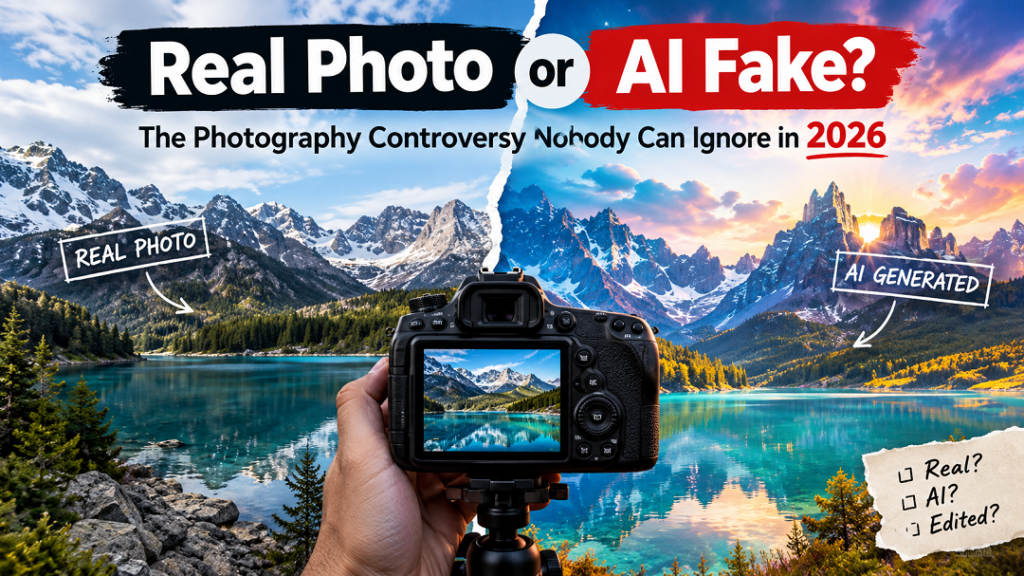
Real Photo or AI Fake? The Photography Controversy Nobody Can Ignore in 2026
Introduction: Can You Still Trust What You See in a Photograph?
A photograph has traditionally been considered a record of reality. Whether it captures a wedding ceremony, a breathtaking landscape, a breaking news event, a fashion campaign, or a precious family moment, photography has helped people preserve memories and understand the world around them.
But in 2026, one question is becoming increasingly difficult to answer: Is this a real photograph, or was it created or altered using artificial intelligence?
AI-powered image generators can now create remarkably realistic pictures of people, buildings, wildlife, products, and imaginary environments. At the same time, traditional photo editing software has become more powerful, allowing photographers to remove unwanted objects, replace backgrounds, enhance lighting, change colors, and reconstruct missing parts of an image.
The result is a growing debate across the photography industry. Professional photographers are questioning how AI-generated images affect their careers. Businesses are reconsidering how they produce advertising visuals. News organizations are facing greater pressure to verify photographs before publishing them. Meanwhile, ordinary social media users are finding it increasingly difficult to distinguish authentic moments from digitally manufactured scenes.
The controversy is not simply about whether artificial intelligence can create beautiful images. It is about trust, creativity, transparency, professional value, and the meaning of photography itself.
Are AI-generated pictures a legitimate new form of visual art? Does extensive photo manipulation make an image misleading? Can traditional photography remain valuable in a world where realistic images can be generated in seconds?
Let’s explore the real-photo-versus-AI debate, the technology behind it, the challenges facing photographers, and the role professional photo editing continues to play in creating high-quality, trustworthy images.
1. What Is the Difference Between a Real Photograph and an AI-Generated Image?
Understanding the controversy begins with recognizing that not every digital image is created in the same way.
A real photograph generally originates from light captured by a camera sensor or photographic film. The photographer chooses the subject, composition, lighting, timing, and perspective. The resulting image records a scene that existed in front of the camera, although the photograph may subsequently be edited.
An AI-generated image, by contrast, is created by an artificial intelligence model that synthesizes visual content from learned patterns, prompts, reference images, or other inputs. It may depict a scene that never existed in the physical world.
However, the distinction is not always straightforward. Some images combine genuine photography with AI-generated elements, while others begin as photographs and undergo extensive digital modification.
Common Types of Images in 2026
1. Authentic camera photographs
These images originate from a camera capturing a real scene. They may receive ordinary adjustments to exposure, contrast, white balance, sharpness, and color.
2. Professionally edited photographs
These are real photographs improved through post-processing. A photo editor may correct lighting, remove dust, retouch skin, adjust colors, replace a distracting background, or prepare an image for commercial use.
3. AI-assisted photographs
These images begin with a real photograph but use AI tools for selected tasks, such as noise reduction, object removal, background expansion, or advanced retouching.
4. Composite photographs
A composite combines two or more visual elements into a single image. Some composites are created entirely from photographed elements, while others include AI-generated components.
5. Fully AI-generated images
These images are synthesized by an AI model rather than captured as a complete scene through a camera. They may look like documentary photographs, studio portraits, fashion campaigns, or travel images despite depicting events or people that never existed.
The important distinction is not simply whether an image has been edited. It is whether the image accurately represents what viewers are being led to believe they are seeing.
2. Why Is AI Photography Becoming Such a Major Controversy?
Artificial intelligence has lowered the barriers to creating convincing visual content. A person without a camera, photography training, a studio, or a professional model can generate images that resemble expensive commercial photography.
This creates new opportunities, but it also raises concerns about authenticity and professional standards.
The Challenge of Realistic AI Images
Modern image-generation systems can produce convincing lighting, realistic-looking skin, detailed backgrounds, attractive compositions, and sophisticated visual styles.
Although AI images may contain telltale errors, those errors are not always obvious. Some generated pictures look convincing at first glance, especially when viewed on a small smartphone screen.
This creates a problem for audiences who have historically treated photographs as evidence.
A fabricated image of a natural disaster, public event, celebrity, or political gathering could influence public opinion if it circulates without appropriate context. A synthetic product image could misrepresent an item being sold. An AI-generated portrait could be mistaken for a real person.
The concern is not that every AI image is deceptive. It is that realistic images can be used deceptively when their origins are hidden.
The Debate Among Professional Photographers
Professional photographers invest in cameras, lenses, lighting equipment, studio spaces, training, travel, and years of practical experience.
AI image generation introduces a different production model. Instead of organizing a shoot, a creator may generate a scene digitally and refine it through multiple prompts and editing steps.
For some assignments, this can reduce production costs. For others, it cannot replace the authenticity, control, human interaction, or documentary value of a real photographic session.
The debate becomes particularly intense when clients compare the price of a professionally photographed image with the cost of generating a similar-looking visual using AI.
However, the comparison is not always fair. A real commercial shoot may involve art direction, model releases, location permissions, product handling, lighting, multiple deliverables, and quality control. A generated image may require its own substantial work in prompting, selection, correction, compositing, and verification.
The real question is whether each method meets the project’s creative, commercial, ethical, and technical requirements.
3. Real Photo vs AI Image: Can You Tell the Difference?
One of the most interesting aspects of the photography controversy is how difficult it can be to identify an image’s origin by appearance alone.
There are visual clues worth examining, but no single clue reliably proves that a photograph is authentic or AI-generated.
Check the Details
Hands and fingers: AI-generated images have historically struggled with complex hand positions, overlapping fingers, and unusual anatomy. Newer systems can produce convincing hands, so correct anatomy is not proof of authenticity.
Text and logos: Look closely at signs, labels, packaging, clothing, and background lettering. Distorted or inconsistent text may suggest synthetic generation or manipulation.
Lighting and shadows: Examine whether shadows, reflections, and highlights agree with the apparent light sources. Inconsistent lighting can be a warning sign, although real photographs can also contain complicated lighting.
Background details: Inspect railings, windows, architectural lines, jewelry, hair, and objects around the main subject. Unnatural transitions or inconsistent geometry may reveal editing or generation.
Textures and patterns: Look closely at skin, fabric, leaves, water, hair, and repeated objects. Unusual texture repetition or overly smooth surfaces can indicate processing, but neither is conclusive.
Context and provenance: Consider who published the image, whether a credible source confirms the event, and whether the original file or other independent photographs are available.
Why Human Inspection Is Not Enough
Visual inspection can identify suspicious details, but modern AI-generated images may not display obvious defects. Conversely, heavy compression, low resolution, beauty filters, and conventional photo editing can make genuine photographs look artificial.
A responsible assessment combines visual examination with source verification, available metadata, contextual evidence, and independent confirmation.
Key takeaway: You cannot reliably determine whether every image is real or AI-generated simply by looking at it.
4. AI Photo Detection: Can Technology Identify Fake Images?
AI image detectors attempt to identify patterns associated with synthetic images. Depending on the system, they may analyze visual features, statistical patterns, image artifacts, or other signals.
These tools can be useful, but their results should be interpreted cautiously.
Why AI Detection Tools Can Make Mistakes
Detection accuracy can be affected by several factors:
- Image compression: Social media platforms often compress uploaded images, removing or changing useful signals.
- Resizing and cropping: Transforming an image may weaken the clues a detector relies on.
- Editing: Retouching, sharpening, color grading, and compositing can alter image characteristics.
- New generation models: A detector trained on older AI systems may perform poorly on images from newer systems.
- Mixed-origin content: A real photograph with AI-generated elements can be difficult to classify using a simple real-or-fake label.
A detector’s confidence score is not the same as verified proof.
For important decisions, use multiple sources of evidence. Examine the original file when possible, check the photographer or publisher’s account, compare related images, and seek independent confirmation.
What Is Image Provenance?
Image provenance refers to information about where an image came from and how it has been created or modified.
Depending on the camera, software, and workflow, useful evidence may include original files, metadata, editing history, signed content credentials, or records supplied by the creator.
Content Credentials based on the C2PA standard can help communicate an image’s origin and editing history when supported information is available and its credentials can be verified.
However, the absence of such credentials does not prove that an image is fake. Credentials may never have been created, may not be supported by a particular workflow, or may have been lost during processing.
Likewise, provenance information should be verified rather than accepted blindly. It can provide valuable context, but it does not automatically establish that every claim made about an image is true.
5. Is Photo Editing Cheating? The Controversy Behind Digital Retouching
AI image generation is not the only source of controversy. Traditional photo editing has raised similar questions for decades.
Photographers have adjusted exposure, retouched negatives, manipulated colors, combined images, and removed imperfections long before modern generative AI tools appeared.
Today, software makes these changes faster and more accessible, but the ethical question remains: when does improving an image become misleading?
Photo Editing for Quality
Professional editing commonly involves:
- Exposure and white balance correction.
- Color grading and tone adjustment.
- Removing dust, sensor spots, and minor distractions.
- Natural skin retouching.
- Sharpening and noise reduction.
- Product color correction.
- Background cleanup.
- Perspective correction and image cropping.
These adjustments can help photographs communicate their intended visual message without fundamentally misrepresenting the subject.
For example, a wedding photographer may correct exposure and color to preserve the atmosphere of a ceremony. A product photographer may remove dust from a surface so customers can focus on the actual product.
When Editing Becomes Misleading
Editing becomes more ethically complicated when it changes facts that matter to the audience.
Examples include altering a documentary photograph to change what happened, removing a significant object from a news image, substantially changing a product’s appearance, or presenting an AI-generated scene as authentic evidence.
Beauty retouching can also create unrealistic expectations when body proportions, skin texture, or facial features are heavily altered without appropriate context.
The same technique may be acceptable in one setting and unacceptable in another. A fantasy advertisement has different expectations from a news photograph or forensic image.
The guiding principle is transparency: editing should be appropriate to the purpose of the image, and material changes should be disclosed when they could mislead viewers.
6. How AI Photography Is Affecting Professional Photographers
The growth of AI-generated images is changing the commercial photography landscape. Its impact varies according to the type of work, the client’s needs, and the photographer’s ability to adapt.
Commercial and Advertising Photography
Some brands can use AI-generated imagery for conceptual campaigns, mood boards, illustrations, or imaginative scenes that would be expensive to produce physically.
However, many commercial assignments still require accurate photographs of real products, genuine locations, real people, or specific brand assets.
For example, an online retailer generally needs product images that accurately represent the item customers will receive. An AI-generated handbag that looks attractive but misrepresents its color, dimensions, or construction could create customer dissatisfaction and commercial risk.
Wedding and Event Photography
AI can assist with editing, culling, noise reduction, and certain retouching tasks. It cannot independently recreate the full value of being present at a once-in-a-lifetime event.
Clients often want genuine emotional moments, real family interactions, and a faithful record of their celebration.
For wedding photographers, the opportunity lies in combining efficient post-processing with authentic storytelling, consistent quality, and personal service.
Portrait and Fashion Photography
AI tools can help create concepts, explore backgrounds, and speed up selected retouching operations.
Nevertheless, real portraits have a personal quality that goes beyond technical appearance. Clients may value genuine expression, accurate representation, and the relationship between the photographer and subject.
Fashion and beauty campaigns also need to consider representation, consent, disclosure, and the potential consequences of creating synthetic images of identifiable people.
Photojournalism and Documentary Photography
Authenticity is especially important when photographs are used to report real events.
News organizations need to distinguish between ordinary technical adjustments and changes that could alter the meaning of an image. Generating missing scene details or inserting objects into documentary photographs can undermine public trust if the result is presented as an unaltered record.
For documentary work, clear editorial standards and reliable provenance are essential.
7. Why Authentic Photography Still Matters in 2026
Despite rapid advances in image generation, authentic photography continues to provide value that goes beyond visual realism.
Real Moments Cannot Always Be Recreated
A genuine smile, an unexpected sporting moment, a wedding embrace, a wildlife encounter, or a historic event can have meaning because it actually happened.
A synthetic image may recreate the appearance of such a moment, but it does not establish that the event occurred.
For families, organizations, journalists, and businesses, this difference can be fundamental.
Photography Provides a Connection to Reality
Authentic photographs can serve as records of people, products, places, and events. When supported by credible context and provenance, they can help audiences understand what was present at a particular time.
Photography is not automatically objective. A photographer chooses what to include, what to exclude, and when to press the shutter. Editing and captions also influence interpretation.
Nevertheless, a genuine photographic record provides a different kind of evidence from a completely synthetic scene.
Professional Skill Remains Valuable
Photography involves much more than operating a camera. It includes lighting, composition, timing, communication, color management, visual storytelling, client direction, and technical consistency.
AI may assist with individual tasks, but professional judgment remains important when the goal is to produce images that meet a specific brief and represent a subject accurately.
8. The Role of Professional Photo Editing in the AI Era
As image creation tools become more sophisticated, the distinction between creating an image and preparing an image for its intended use becomes increasingly important.
Professional photo editing focuses on improving the quality, consistency, and presentation of visual content while respecting the client’s requirements.
For businesses, photographers, e-commerce sellers, studios, and creative agencies, a reliable editing workflow can make a substantial difference in the final result.
Why Professional Photo Editing Matters
Consistent image quality: A collection of photographs may be captured under different lighting conditions. Professional editing helps create a cohesive appearance across the complete set.
Accurate product representation: Commercial images need careful attention to color, shape, texture, proportions, and fine details.
Natural retouching: Portraits can benefit from thoughtful corrections that preserve realistic skin texture and individual characteristics.
Clean backgrounds and compositions: Removing distractions, refining edges, and correcting perspective can help subjects stand out.
Production efficiency: Outsourcing suitable editing tasks can help photographers spend more time on shooting, creative direction, and customer relationships.
Quality control: An experienced editor can review images for consistency, technical defects, and delivery requirements before the final files are supplied.
Professional editing is not about making every image look artificial. It is about understanding the project’s purpose and applying the right corrections.
AI-Assisted Editing vs. Human Photo Editing
AI-powered tools can automate repetitive work and accelerate selected operations. Human editors provide context, creative judgment, detailed review, and decisions based on the client’s specific requirements.
For many projects, a hybrid workflow can offer the best balance: automation for suitable repetitive tasks and skilled human review for accuracy, refinement, and quality control.
The appropriate approach depends on the image type, volume, deadline, budget, and required level of authenticity.
9. Real Photo vs AI Fake: What Businesses Should Consider Before Publishing Images
Businesses increasingly rely on visual content for websites, social media, online marketplaces, digital advertisements, and promotional campaigns.
Choosing between real photography, edited photography, and AI-generated imagery should be a deliberate decision rather than simply a question of cost or convenience.
Questions to Ask Before Publishing an Image
1. Does the image represent a real product or event?
If customers need to understand the actual appearance of a product, use photographs that accurately represent the item.
2. Is AI-generated content permitted in this context?
Review platform policies, advertising requirements, industry standards, and applicable laws before publishing synthetic imagery.
3. Could viewers reasonably misunderstand the image?
If the image could be mistaken for documentary evidence, a genuine testimonial, or an actual product photograph, additional review or disclosure may be appropriate.
4. Do you have permission to use the image?
Confirm licensing, model releases where applicable, commercial-use rights, and any necessary permissions for source material.
5. Does the image meet the required quality standards?
Review resolution, color accuracy, sharpness, background quality, composition, and consistency across the complete image collection.
6. Should AI involvement be disclosed?
Consider the audience, context, applicable rules, and whether disclosure is needed to avoid creating a misleading impression.
Businesses that establish these checks can reduce confusion and protect customer trust.
10. The Legal and Ethical Questions Behind AI-Generated Images
The legal treatment of AI-generated imagery differs across jurisdictions and depends on the facts of each case. Copyright, privacy, publicity rights, consumer protection, and contractual obligations may all be relevant.
For photographers and businesses, several issues deserve attention.
Copyright and Ownership
The copyright status of AI-generated content can depend on the jurisdiction, the level of human creative contribution, the material used to produce the image, and applicable legal developments.
Photographers should review the licensing terms of the tools they use and understand the rights attached to both source material and final outputs.
They should not assume that every AI-generated image is automatically free of copyright restrictions or that a generated image can always be used commercially without risk.
Consent and Likeness
Using AI to create or alter an identifiable person’s likeness can raise privacy, consent, publicity, or other legal concerns.
This is particularly important when images are used for advertising, political messaging, sensitive situations, or content that could damage someone’s reputation.
Misleading Advertising
If a product image significantly differs from the product a customer receives, the image may create consumer-protection concerns.
Businesses should ensure that promotional visuals accurately communicate relevant product features and do not create a false impression about performance, appearance, or results.
Professional Responsibility
Photographers, editors, publishers, and clients should agree on how much editing is acceptable, whether AI tools may be used, and when disclosure is required.
Clear agreements can prevent misunderstandings and help protect both creative professionals and their customers.
This discussion is general information, not legal advice. Specific legal questions should be reviewed with a qualified professional in the relevant jurisdiction.
11. How to Verify Whether a Photograph Is Genuine: A Practical Checklist
If you encounter a suspicious image online, use the following process before sharing it or treating it as evidence.
Step 1: Find the original source.
Look for the earliest available publication, the photographer’s website, an official account, or a reputable news source.
Step 2: Search for other versions.
Reverse image search can help identify earlier appearances, similar images, or the original photograph from which a modified version was created.
Step 3: Inspect the full-resolution image.
Examine hands, reflections, text, shadows, repeated patterns, and background geometry. Treat these observations as clues rather than definitive proof.
Step 4: Review available metadata.
The file may contain camera information, timestamps, software details, or other metadata. Remember that metadata can be missing, altered, or incomplete.
Step 5: Check provenance credentials.
If Content Credentials or other verifiable provenance information are available, inspect them to understand the recorded origin and editing history.
Step 6: Compare independent evidence.
For an alleged news event, check other photographs, video footage, official statements, and reliable reporting.
Step 7: Use detection tools carefully.
An AI detector may offer another clue, but its result should not be treated as the sole basis for a conclusion.
Step 8: Avoid sharing unverified claims.
If you cannot establish the image’s authenticity, describe the uncertainty instead of labeling it definitively real or fake.
The safest approach combines technical analysis with credible sources and independent verification.
12. The Future of Photography: Will AI Replace Human Photographers?
AI will continue to influence how images are created, edited, distributed, and evaluated. However, the future is unlikely to be a simple choice between traditional photography and artificial intelligence.
Instead, different approaches will serve different needs.
AI may be particularly useful for concept development, synthetic illustrations, background generation, and certain repetitive editing tasks. Traditional photography will remain important for authentic events, portraits, physical products, documentary work, and assignments requiring real-world accuracy.
Professional editors may increasingly combine conventional retouching with AI-assisted tools. Photographers may focus more strongly on creative direction, client relationships, unique access, visual storytelling, and authenticity.
The industry will also need better systems for provenance, disclosure, licensing, and verification.
Skills Photographers Can Develop to Stay Competitive
- Master lighting, composition, color, and visual storytelling.
- Learn professional retouching and advanced post-processing.
- Understand AI-assisted editing and its limitations.
- Develop expertise in a specific photography niche.
- Improve communication and client-management skills.
- Learn image licensing, consent, and authenticity standards.
- Build a portfolio that demonstrates both technical quality and creative judgment.
Photographers who understand both the creative possibilities and the ethical responsibilities of modern image production will be better positioned to respond to changing client expectations.
13. Real Photo or AI Fake? The Debate Everyone Should Be Having
The controversy surrounding AI photography is ultimately about more than technology.
It concerns what people expect an image to represent.
A fictional image created with AI can be a valuable piece of art. A carefully edited photograph can be a professional masterpiece. A genuine photograph can document a meaningful moment. Each has a place when its purpose is clear.
Problems arise when the boundaries are hidden and audiences are encouraged to believe something that is not true.
Professional photographers should not need to reject every new tool to defend their craft. AI creators should not need to pretend that synthetic scenes were captured by a camera. Businesses should not need to sacrifice accuracy for attractive marketing. Audiences should have a reasonable opportunity to understand what they are viewing.
The strongest future for photography is one in which creativity and technology develop alongside honesty, quality, and transparency.
Ultimately, the most important question may not be whether an image was created by a camera or an AI model. It may be whether the image is being presented honestly and whether viewers can trust the claims being made about it.
14. Frequently Asked Questions About Real Photos and AI-Generated Images
What is the difference between a real photo and an AI-generated image?
A real photograph records light from a physical scene through a camera or photographic medium. An AI-generated image is synthesized by an artificial intelligence model. Images can also combine genuine photographic material with AI-generated elements.
Can AI-generated images look exactly like real photographs?
AI-generated images can look highly realistic, sometimes making visual identification difficult. However, realism alone does not establish authenticity, and not every AI image is free from visual inconsistencies.
How can I tell whether a photograph is AI-generated?
Inspect visual details, check the original source, review available metadata and provenance credentials, and compare independent evidence. AI detection tools can provide additional clues, but no single method guarantees a correct result in every case.
Is photo editing considered cheating?
No. Photo editing is a normal part of many photographic workflows. Whether editing is appropriate depends on the purpose of the image, the extent of the changes, and whether the result misleads viewers.
Is AI photography replacing professional photographers?
AI is changing some creative and commercial workflows, but its impact varies by photography niche. Real events, physical products, documentary work, client interaction, and specialized creative direction can still require professional photographers.
Are AI-generated images legal to use commercially?
Commercial use depends on the tool’s terms, the source material, applicable intellectual-property rules, likeness rights, and other legal requirements. Users should review the relevant conditions before publishing or selling AI-generated imagery.
Why is authenticity important in photography?
Authenticity matters when photographs are used to document events, represent real people, advertise products, preserve memories, or support factual claims. Viewers need to understand whether an image is a genuine record, a modified photograph, or a synthetic creation.
What is professional photo editing?
Professional photo editing involves improving photographs through techniques such as color correction, exposure adjustment, retouching, background cleanup, image enhancement, and quality control. The goal is to deliver images that meet a project’s creative and technical requirements.
Can AI and professional photo editing work together?
Yes. AI tools can accelerate selected editing tasks, while skilled editors provide creative judgment, detailed corrections, consistency, and quality control. A combined workflow can be effective when it matches the project’s requirements.
What should businesses check before using AI-generated images?
Businesses should consider accuracy, disclosure, licensing, permissions, platform policies, customer expectations, and whether the image could create a misleading impression. Product images should accurately represent products when customers rely on them to make purchasing decisions.
Conclusion: Better Images Begin With the Right Editing Partner
The real-photo-versus-AI controversy is changing the photography industry, but one principle remains important: high-quality visual content requires the right combination of creativity, technical skill, accuracy, and attention to detail.
Whether you are a professional photographer preparing a client gallery, an e-commerce business developing product images, a studio managing large volumes of photographs, or a brand building a consistent visual identity, professional post-production can help your images meet their intended purpose.
AI tools may accelerate certain tasks, but thoughtful editing and quality control remain essential for producing polished, consistent, and commercially suitable photographs.
Looking for Professional Photo Editing Services?
At Photo Editing Services Company., we understand the importance of presenting images professionally in an increasingly competitive visual marketplace.
Visit our website to explore our photo editing services and discover solutions for your photography and business image requirements.
Website: https://www.photoeditingservicesco.com/
Whether you need image enhancement, retouching, background refinement, or professional post-production support, choose an editing workflow that matches your project, brand standards, and delivery requirements.
Make every image count. Visit Photo Editing Services Company. to learn more about professional photo editing solutions for your next project.
