
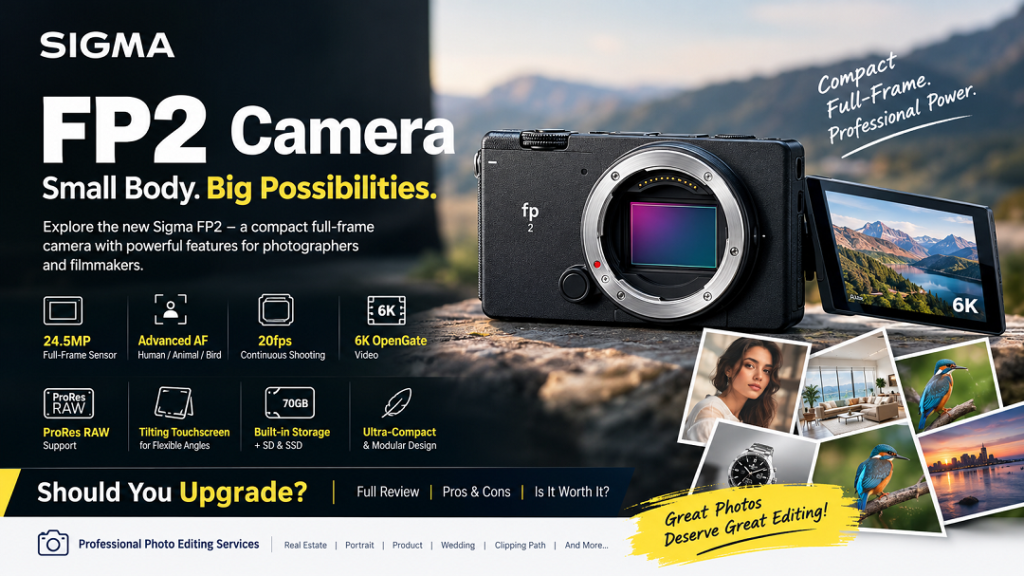
Sigma FP2 Camera: Features, Pros & Cons, and Is It Worth Upgrading in 2026?
Sigma has officially introduced the Sigma FP2, bringing a major update to its ultra-compact full-frame camera concept. Announced on October 23, 2026, the new FP2 combines a 24.5-megapixel partially stacked full-frame sensor, improved autofocus, 20 fps continuous shooting, 6K OpenGate video, a tilting touchscreen, approximately 70GB of internal storage, and enhanced professional video capabilities.
The camera is scheduled to become available on November 11, 2026, with a U.S. body-only price of $2,199.
Rather than abandoning the unusual philosophy of the original Sigma fp, Sigma has developed it further. The FP2 remains extremely compact and modular, but many of the limitations that made the original fp a specialist camera have been addressed.
So, is the Sigma FP2 a serious upgrade? Who should buy it? And does its improved imaging technology mean photographers can spend less time editing their photos?
Here is a detailed look at the new camera.
What Is the Sigma FP2?
The Sigma FP2 is a compact full-frame L-Mount mirrorless camera designed to work as both a still photography camera and a cinema camera.
Sigma describes the concept using three words:
Small. Powerful. Adaptable.
The idea is simple: photographers can use the FP2 as a lightweight camera with minimal accessories or build a larger professional system around it when a production requires additional equipment.
A dedicated switch lets users move between STILL and CINE modes, with interfaces and controls optimized for each type of shooting.
This makes the FP2 particularly interesting for hybrid creators who regularly switch between photography and filmmaking.
Sigma FP2 Key Specifications
Sensor: 24.5MP full-frame partially stacked CMOS
Lens mount: L-Mount
Autofocus: Phase-detection + contrast-detection AF
Subject detection: Human, dog, cat and bird detection with Eye AF
Continuous shooting: Up to approximately 20 fps
RAW format: DNG
Maximum shutter speed: 1/25,600 sec
Shutter: Electronic
Screen: 3.15-inch tilting touchscreen, approximately 2.1 million dots
Screen movement: Approximately 90° upward and 45° downward
Internal storage: Approximately 70GB
Memory card: SDXC UHS-II
External storage: SSD via USB 3.2
Video: Up to 6K OpenGate
Professional video: ProRes RAW / ProRes RAW HQ support
Dynamic range: Up to 14.1 stops in specified 4K full-frame L-Log conditions
Image stabilization: Electronic stabilization for video only
Battery life: Approximately 370 photographs or 130 minutes of video
Viewfinder: Optional external electronic viewfinder
Body dimensions: Approximately 112.8 × 69.9 × 41.8mm
Body weight: Approximately 376g without battery/card
These specifications reveal something important: the FP2 isn’t simply an original fp with a few software improvements. The imaging pipeline, autofocus, video capabilities and usability have received substantial attention.
New 24.5MP Partially Stacked Full-Frame Sensor
One of the most important improvements is the 24.5-megapixel partially stacked CMOS sensor.
Resolution alone doesn’t tell the story.
A 24.5MP resolution may sound relatively modest compared with today’s extremely high-resolution mirrorless cameras, but Sigma is prioritizing a balance between image quality, speed, video performance and manageable file sizes.
The faster sensor readout helps reduce rolling-shutter distortion while supporting faster continuous shooting and high-frame-rate video.
That is particularly important because the FP2 relies on an electronic shutter.
For photographers, the 24.5MP resolution should provide ample detail for portraits, travel photography, street photography, real estate, commercial photography and many professional applications without creating unnecessarily enormous files.
Much Better Autofocus
Autofocus was one of the areas where the original Sigma fp could feel limited compared with mainstream mirrorless competitors.
The FP2 makes a significant improvement.
It uses a hybrid system combining image-plane phase-detection autofocus with contrast detection.
The camera can recognize:
- Humans
- Dogs
- Cats
- Birds
- Eyes
Improved subject tracking should make the FP2 considerably more practical for photographing moving people, pets, wildlife, events and everyday subjects.
Bird detection is particularly noteworthy because it expands the camera’s usefulness beyond studio, landscape and controlled filmmaking environments.
Up to 20fps Continuous Shooting
The Sigma FP2 can shoot at approximately 20 frames per second.
At the maximum rate, Sigma specifies bursts of up to approximately:
200 JPEG images
or
180 DNG RAW images
This is an impressive capability for such a small full-frame camera.
Fast bursts can be useful for street photography, action, wildlife, pets, events and other situations where the perfect expression or movement may last only a fraction of a second.
However, photographers should remember that the FP2 uses an electronic shutter rather than a conventional mechanical shutter.
6K OpenGate Changes the Video Story
Video is arguably where the FP2 becomes especially interesting.
The camera supports 6K OpenGate recording.
Instead of limiting recording to a conventional 16:9 portion of the sensor, OpenGate recording can make use of the larger sensor area. That provides filmmakers with much greater flexibility during post-production.
For example, footage from the same recording can potentially be reframed for different delivery formats.
A creator might need:
16:9 for YouTube
9:16 for Instagram Reels or YouTube Shorts
1:1 for social media
Other cinematic aspect ratios for film projects
Capturing more sensor information gives editors additional room to crop and reposition footage.
The FP2 supports 6K recording at frame rates up to 59.94 fps in supported compressed formats, while Apple ProRes RAW and ProRes RAW HQ are supported up to 6K 29.97 fps.
It can also shoot 4K at up to 59.94 fps, with 100/119.88 fps available in crop mode.
For creators who shoot once and publish across multiple platforms, this flexibility can be extremely valuable.
Up to 14.1 Stops of Dynamic Range
Sigma specifies up to 14.1 stops of dynamic range when shooting 4K full-frame L-Log under its stated conditions.
Dynamic range is especially important when a scene contains both very bright and very dark areas.
Think about:
- A real estate interior with bright windows
- An outdoor portrait in strong sunlight
- A sunset landscape
- A wedding ceremony with mixed lighting
- A commercial interior
- A cinematic scene containing deep shadows
Greater usable dynamic range gives photographers and filmmakers more information to work with during post-production.
It doesn’t eliminate editing. In many situations, it actually provides the editor with more creative flexibility.
ProRes RAW and L-Log Support
The FP2 is clearly designed with serious post-production workflows in mind.
It supports Apple ProRes RAW and Leica’s L-Log.
RAW video provides greater flexibility for professional post-production, while log recording preserves tonal information that can later be transformed through color correction and color grading.
For professional filmmakers, this can mean greater control over:
- Exposure
- Highlights
- Shadows
- White balance
- Contrast
- Color
- Skin tones
- Final cinematic look
The FP2 therefore isn’t designed around the idea of eliminating post-production. Its professional features make high-quality post-production an important part of the workflow.
Approximately 70GB of Internal Storage
Another useful addition is approximately 70GB of built-in storage.
The FP2 also supports UHS-II SD cards and external SSD recording through USB.
Internal storage provides photographers and filmmakers with an additional safety net. If a memory card becomes full, having internal capacity available can be extremely useful.
It is also convenient for situations where a photographer needs to begin shooting quickly.
Finally, a Tilting Screen
The original minimalist fp design came with compromises, and its fixed display was one of them.
The FP2 introduces a 3.15-inch tilting touchscreen that can tilt approximately:
90 degrees upward
and
45 degrees downward
That makes low-angle and high-angle compositions considerably easier.
Street photographers, videographers, architectural photographers and creative portrait photographers should particularly appreciate this improvement.
Improved Battery Life
Small cameras often struggle with battery endurance.
Sigma says the FP2 provides approximately 30% longer battery life than the original fp, with ratings of around:
370 still photographs
or
130 minutes of video
The improvement is welcome, although professionals working on long shoots will probably still want spare batteries or external power options.
Sigma FP2 Pros
1. Extremely Compact Full-Frame Design
Its compact body is one of the FP2’s strongest selling points. Photographers can obtain full-frame image quality without carrying a traditionally large full-frame camera body.
2. Fast Partially Stacked Sensor
The new sensor provides faster readout, helping reduce rolling shutter while enabling better burst and video performance.
3. Improved Autofocus
Phase-detection AF and expanded subject recognition make the FP2 considerably more versatile than the original concept.
4. 20fps Burst Shooting
A maximum rate of approximately 20 fps makes this tiny camera surprisingly capable for moving subjects.
5. 6K OpenGate Video
This is a major advantage for filmmakers and content creators who need flexibility for multiple platforms and aspect ratios.
6. ProRes RAW Support
Professional filmmakers gain considerably greater post-production flexibility.
7. Tilting Touchscreen
A seemingly simple change makes the camera much easier to use from creative shooting angles.
8. Built-In Storage
Approximately 70GB of internal storage adds flexibility alongside SD cards and external SSD support.
9. STILL and CINE Modes
The ability to quickly change between dedicated photography and filmmaking interfaces strengthens its appeal as a hybrid camera.
10. L-Mount Ecosystem
Users have access to compatible L-Mount lenses from Sigma and other members of the L-Mount ecosystem.
Sigma FP2 Cons
No camera is perfect, and the FP2 still has compromises.
1. No Mechanical Shutter
The FP2 continues with an electronic-shutter-only design.
The faster partially stacked sensor should reduce rolling shutter compared with slower-readout designs, but photographers who strongly prefer a mechanical shutter need to consider this limitation.
2. No Built-In EVF
There is no traditional integrated electronic viewfinder.
Sigma offers an optional external EVF, but photographers accustomed to raising a camera directly to their eye may see this as a significant disadvantage.
3. No Sensor-Shift IBIS
The FP2 does not have conventional in-body sensor-shift image stabilization.
Electronic image stabilization is available for video, but photographers wanting stabilized handheld stills must consider lens stabilization, shooting technique or other support.
4. 24.5MP May Not Suit Everyone
For most photography, 24.5MP is plenty.
However, photographers specializing in extremely large prints, heavy cropping, detailed landscapes or certain commercial applications may prefer a higher-resolution camera.
5. Modular Design Can Increase the Real Cost
The small body is attractive, but adding a viewfinder, cage, grip, storage and other accessories can increase both the overall size and investment.
6. Battery Life Is Better, Not Class-Leading
Approximately 370 photographs is an improvement, but demanding professionals will still want additional power for long shooting days.
Sigma FP2 vs Original Sigma fp: Why Upgrade?
For existing Sigma fp owners, this is perhaps the most important question.
The original fp was introduced in 2019 and built its reputation around being an extraordinarily compact and modular full-frame camera.
Seven years later, the FP2 retains that philosophy while modernizing many of the technologies around it.
Upgrade for the New Sensor
The partially stacked 24.5MP sensor provides faster readout and should make the camera more responsive in demanding situations.
Upgrade for Better Autofocus
If autofocus performance has been one of your frustrations with the original fp, the FP2 is significantly more compelling.
Phase detection and modern subject recognition are major practical improvements.
Upgrade for 20fps Shooting
Photographers who capture movement gain a much faster camera.
Upgrade for 6K OpenGate
For serious filmmakers, this could be one of the biggest reasons to upgrade.
OpenGate provides substantially more flexibility for reframing and multi-platform production.
Upgrade for the Tilting Display
If you frequently shoot from unusual perspectives, the new screen alone makes day-to-day operation more convenient.
Upgrade for Internal Storage
Approximately 70GB of internal memory adds another useful layer of flexibility.
Upgrade for Better Battery Life
A roughly 30% improvement over the original fp reduces one of the compromises associated with using such a small camera.
Who Should Upgrade to the Sigma FP2?
The FP2 makes the most sense for:
Existing Sigma fp users who want better AF, faster performance and significantly improved video capabilities.
Hybrid photographers and filmmakers who need one small camera for both stills and cinema work.
Travel photographers who value compact equipment.
Street photographers who want a discreet full-frame setup.
Independent filmmakers who need a modular cinema platform.
YouTubers and content creators who want 6K OpenGate flexibility.
Professional video creators who use RAW and log-based post-production workflows.
It could also appeal to photographers who simply want something different from the conventional DSLR-style mirrorless body.
Who Probably Doesn’t Need to Upgrade?
Not every photographer needs the FP2.
If your existing camera already produces excellent images and you primarily photograph static subjects, buying a new body may not dramatically improve your photography.
High-resolution photographers may also prefer cameras offering substantially more than 24.5MP.
Sports photographers who require specialized professional ergonomics, extremely long battery endurance and integrated viewfinders may be better served by larger flagship bodies.
Likewise, photographers who consider in-body sensor stabilization essential should carefully consider the FP2’s video-only electronic stabilization approach.
Does a Better Camera Mean Less Photo Editing?
This is where photographers sometimes misunderstand camera technology.
A better camera can capture better source data, but that does not automatically create a finished professional image.
Even with a modern full-frame sensor, strong dynamic range and sophisticated autofocus, photographers may still need to correct or enhance:
- Exposure
- White balance
- Color accuracy
- Highlights and shadows
- Contrast
- Lens distortion
- Perspective
- Noise
- Skin imperfections
- Distracting objects
- Backgrounds
- Composition and cropping
The camera captures the information.
Post-production determines how that information becomes the final image.
This becomes particularly important in professional photography.
Sigma FP2 for Real Estate Photography
The FP2’s full-frame sensor and wide dynamic range could make it an interesting compact option for property photography.
However, even a technically excellent RAW photograph may need professional real estate post-processing.
For example, an interior photograph may contain bright windows and darker rooms. Professional editing can balance these areas while maintaining a natural appearance.
Real estate images may also require:
- HDR blending
- Window masking
- Perspective correction
- Vertical line correction
- Lens correction
- White balance correction
- Color correction
- Sky replacement
- Object removal
- Lawn enhancement
- Exposure balancing
- Day-to-dusk conversion
A new camera improves capture quality, but presentation still matters when photographs are being used to market a property.
Sigma FP2 for Portrait Photography
A 24.5MP full-frame sensor offers plenty of resolution for most portrait applications.
But professional portrait photography rarely ends when the shutter is pressed.
Portrait post-production can include:
- Skin retouching
- Blemish removal
- Stray hair cleanup
- Teeth correction
- Eye enhancement
- Background cleanup
- Clothing corrections
- Exposure adjustment
- Skin-tone correction
- Color grading
The objective should not be to make a person look artificial. Good portrait retouching preserves natural texture while removing unnecessary distractions.
Sigma FP2 for Product Photography
Product photographers could also benefit from the compact full-frame setup, especially when paired with appropriate L-Mount lenses and controlled lighting.
Ecommerce photographs, however, often require strict post-production standards.
Product editing may include:
- Clipping paths
- Background removal
- Pure white backgrounds
- Shadow creation
- Dust removal
- Scratch removal
- Reflection correction
- Color matching
- Product retouching
- Image resizing
- Marketplace-ready formatting
Accurate post-production is particularly important when hundreds or thousands of product photographs need a consistent appearance.
Sigma FP2 for Professional Video Production
The FP2 becomes particularly compelling here.
6K OpenGate, L-Log, ProRes RAW and professional post-production support make it much more than a photography camera with a video mode.
High-quality source footage provides editors with greater freedom for:
- Color correction
- Color grading
- Exposure balancing
- Noise reduction
- Reframing
- Stabilization
- Multi-platform cropping
- Transitions
- Audio enhancement
- Titles and graphics
- Final delivery
The camera therefore fits naturally into a capture-to-post-production workflow.
Is the Sigma FP2 Worth Buying in 2026?
For the right photographer or filmmaker, yes.
The Sigma FP2 isn’t trying to be a conventional full-frame mirrorless camera.
Its appeal comes from combining an unusually compact body with a full-frame partially stacked sensor and serious hybrid capabilities.
The strongest reasons to consider it are:
24.5MP partially stacked full-frame sensor
Much improved autofocus
20fps continuous shooting
6K OpenGate recording
ProRes RAW support
Tilting touchscreen
Approximately 70GB internal storage
Improved battery life
Highly modular design
On the other hand, the absence of an integrated EVF, mechanical shutter and sensor-shift IBIS means buyers should evaluate their particular shooting style before upgrading.
The FP2 looks especially compelling for creators who value portability and want to build their camera around a particular assignment rather than carrying a large fixed system everywhere.
Final Thoughts: Great Cameras Still Need Great Post-Production
The Sigma FP2 represents a substantial evolution of Sigma’s compact full-frame philosophy.
Its new sensor, faster autofocus, high-speed shooting and sophisticated cinema capabilities solve several weaknesses associated with the original concept while retaining the unusual modular design that made the fp series distinctive.
But cameras and post-production solve different problems.
A professional camera gives photographers better raw material. Professional editing transforms that material into a polished image ready for clients, advertising, ecommerce, property listings, portfolios and publications.
Need Professional Photo Editing After Your Shoot?
Photo Editing Services Company provides professional human photo editing and retouching services for photographers, real estate businesses, ecommerce companies and creative professionals.
Our experienced editors can help with:
- Real estate photo editing
- Portrait retouching
- Product photo retouching
- Wedding photo editing
- Clipping paths
- Image masking
- Background removal
- HDR image blending
- Sky replacement
- Object removal
- Color correction
- Photo restoration
- 360° panorama stitching
- Virtual staging
- Day-to-dusk conversion
- Professional video editing
Whether your images come from the new Sigma FP2 or another professional camera, careful human post-production can help turn technically strong captures into polished, client-ready visuals.
With more than 10 years of photo editing experience, Photo Editing Services Company supports photographers and businesses that need professional quality, consistency and scalable image-editing capacity.
Captured a great photograph? Let professional post-production help you get the most from it.
