
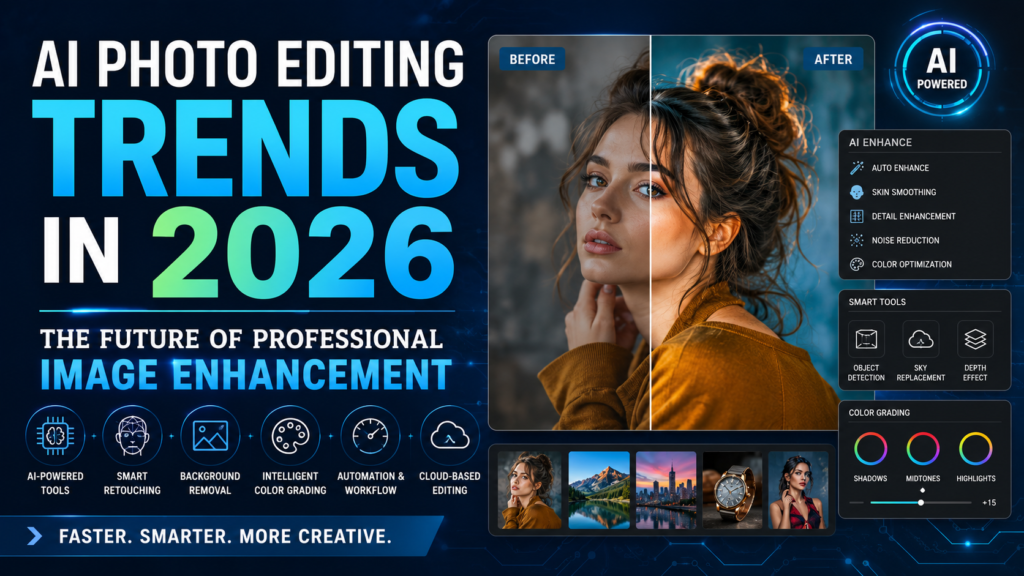
AI Photo Editing Trends in 2026: The Future of Professional Image Enhancement
Artificial intelligence (AI) is transforming the photography industry faster than ever before. What once required hours of careful manual editing can now be completed in minutes with intelligent software that understands subjects, lighting, colors, and composition. In 2026, AI is no longer just an optional feature—it has become an essential part of modern photo editing workflows for photographers, designers, eCommerce businesses, marketing agencies, and content creators.
From automatic background removal and portrait retouching to advanced object selection and intelligent color grading, AI-powered editing tools continue to evolve, helping professionals save time while maintaining high-quality results. However, despite these advancements, human creativity and professional expertise remain irreplaceable. AI serves as a powerful assistant, but the artistic vision behind an outstanding image still depends on skilled editors and photographers.
This article explores the biggest AI photo editing trends shaping 2026, how they impact different industries, their benefits, challenges, and what photographers should expect in the years ahead.
The Rise of AI in Photo Editing
Over the past few years, AI has become deeply integrated into leading photo editing software. Instead of relying solely on manual selections, masks, and adjustments, editors now use intelligent tools that analyze an image before making recommendations or completing complex tasks automatically.
Modern AI systems can recognize people, skies, landscapes, products, buildings, pets, vehicles, and even facial features with remarkable accuracy. This allows photographers to edit images much faster while maintaining consistency across large projects.
The adoption of AI is growing because businesses need faster turnaround times, especially in industries such as eCommerce, real estate, fashion, advertising, and digital marketing.
Trend 1: Smarter AI-Powered Object Selection
Object selection has become one of the most significant AI improvements in 2026.
Earlier editing workflows often required manually tracing objects using selection tools. Today’s AI systems automatically identify subjects with impressive precision.
AI can accurately detect:
- Hair
- Fur
- Transparent objects
- Jewelry
- Clothing
- Vehicles
- Buildings
- Products
- People
This technology dramatically reduces editing time while improving accuracy for background removal and composite editing.
Trend 2: Intelligent Background Replacement
Background replacement is becoming more natural than ever.
Modern AI doesn’t simply remove a background—it analyzes lighting direction, shadows, reflections, depth, and perspective before generating a replacement.
This allows photographers to create realistic product photography, marketing images, portraits, and advertising campaigns without expensive studio setups.
Trend 3: AI Portrait Retouching
Portrait editing has become significantly more intelligent.
Rather than applying generic skin smoothing, AI now recognizes different facial features independently.
Editors can enhance:
- Skin texture
- Eyes
- Lips
- Teeth
- Hair
- Facial lighting
- Skin tone
Professional photographers still perform final refinements, but AI greatly reduces repetitive retouching work.
Trend 4: Faster Batch Editing
Photographers often edit hundreds or even thousands of photographs from weddings, sporting events, or commercial projects.
AI now analyzes image collections and automatically applies consistent adjustments for exposure, white balance, color grading, and cropping across entire photo sets.
This improves consistency while saving valuable production time.
Trend 5: AI Noise Reduction
High ISO photography has always introduced digital noise.
Modern AI-powered noise reduction preserves important image details while eliminating unwanted grain.
This is particularly valuable for:
- Wildlife photographers
- Sports photographers
- Event photographers
- Wedding photographers
- Night photographers
The latest AI models distinguish between image texture and digital noise much more accurately than previous algorithms.
Trend 6: Intelligent Color Grading
Color grading is becoming increasingly automated without sacrificing creative control.
AI can analyze:
- Skin tones
- Natural lighting
- Landscape colors
- Product colors
- Seasonal lighting conditions
Editors receive intelligent recommendations while maintaining complete control over the final appearance.
Trend 7: AI Image Restoration
Old photographs continue benefiting from AI restoration technology.
Modern systems can repair:
- Scratches
- Tears
- Dust
- Color fading
- Blur
- Missing details
Families, museums, historians, and professional restoration companies increasingly rely on AI-assisted restoration while experienced editors complete final refinements.
Trend 8: Cloud-Based AI Editing
Cloud computing is changing how photographers work.
Instead of relying solely on desktop computers, photographers can access powerful AI editing tools through cloud platforms.
Benefits include:
- Device synchronization
- Remote collaboration
- Automatic backups
- Faster processing
- Easy file sharing
Cloud-based editing makes professional workflows more flexible than ever.
Trend 9: AI for eCommerce Photography
Online shopping continues expanding worldwide.
Retailers need thousands of consistent product images for marketplaces and websites.
AI helps automate:
- Background removal
- Shadow creation
- Color correction
- Product alignment
- Image resizing
- Quality enhancement
This reduces production costs while maintaining visual consistency across catalogs.
Trend 10: Human Creativity Still Matters
Despite rapid AI advancements, professional editors remain essential.
Artificial intelligence cannot fully understand:
- Brand identity
- Emotional storytelling
- Creative direction
- Artistic vision
- Client preferences
- Marketing psychology
Professional editors use AI to increase efficiency, but creativity remains a human skill.
The future belongs to photographers who combine technical expertise with AI-assisted workflows.
Benefits of AI Photo Editing
AI technology offers several important advantages:
- Faster editing workflows
- Greater consistency
- Reduced repetitive work
- Improved image quality
- Better client turnaround times
- Enhanced productivity
- Easier editing for beginners
- Improved business scalability
Challenges of AI Editing
Although AI offers many benefits, there are challenges.
These include:
- Over-editing images
- Unrealistic results
- Ethical concerns
- Copyright questions
- Dependence on automation
- Loss of creative individuality
Professional photographers should use AI responsibly while maintaining authentic visual storytelling.
Industries Benefiting from AI Photo Editing
AI editing is transforming many industries, including:
- Wedding photography
- Fashion photography
- Product photography
- Real estate
- Advertising
- Social media marketing
- Digital publishing
- Travel photography
- Automotive photography
- Food photography
Frequently Asked Questions
Will AI replace professional photo editors?
No. AI improves efficiency but cannot replace human creativity, artistic judgment, and client communication.
Is AI photo editing suitable for beginners?
Yes. AI simplifies many complex editing tasks, making professional-quality editing more accessible.
What software uses AI photo editing?
Many modern editing platforms include AI features for masking, object removal, portrait enhancement, and noise reduction.
Can AI edit RAW photographs?
Yes. Many AI-powered editing applications now support professional RAW image workflows.
Is AI editing accurate?
Modern AI is highly accurate, but professional review remains essential for commercial-quality work.
Conclusion
AI photo editing in 2026 represents a significant step forward for the creative industry. Intelligent masking, automated retouching, background replacement, noise reduction, cloud editing, and smart color grading are helping photographers produce exceptional images more efficiently than ever before.
Rather than replacing professional editors, AI has become a valuable creative partner that handles repetitive tasks while allowing photographers to focus on storytelling, composition, and artistic vision.
As technology continues evolving, the most successful photographers will be those who embrace AI while preserving the human creativity that makes every image unique.
Need Professional Photo Editing Services?
Even with the latest AI-powered editing tools, achieving premium-quality results often requires the expertise of experienced photo editors. If you’re a photographer, eCommerce business, agency, or brand looking for reliable post-production support, Photo Editing Services Company. offers professional image editing solutions tailored to your needs.
Their services include:
- Clipping Path Services
- Background Removal
- High-End Photo Retouching
- Image Masking
- Product Photo Editing
- Ghost Mannequin Effects
- Jewelry Photo Retouching
- Real Estate Photo Enhancement
- Color Correction
- Bulk Image Editing
Learn more about their professional editing services at:
- Author Details
