
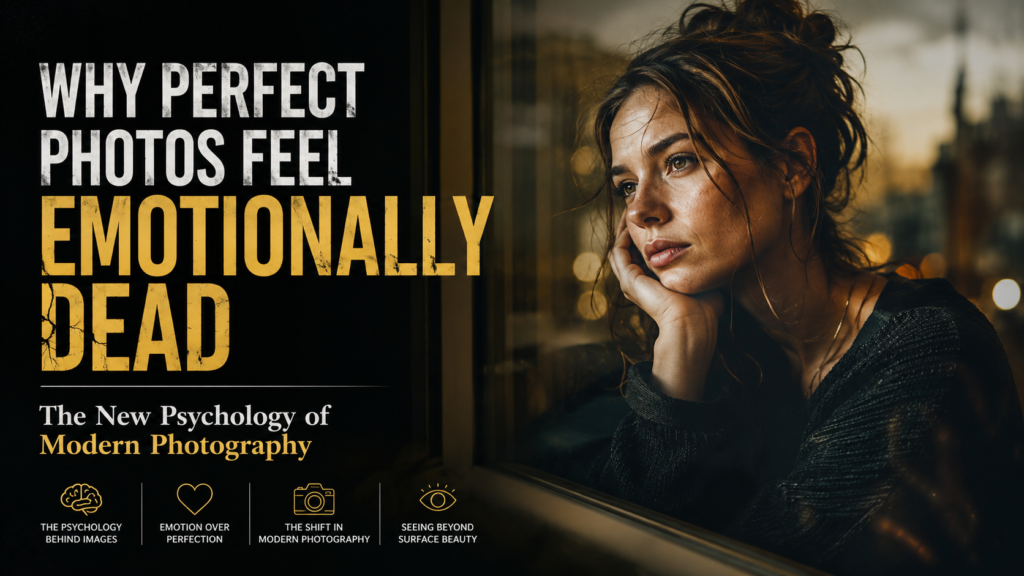
Why Perfect Photos Feel Emotionally Dead: The New Psychology of Modern Photography
Modern photography has reached a strange point.
Cameras are sharper than ever.
Editing software is more advanced than ever.
Artificial intelligence can now generate flawless faces, perfect lighting, and cinematic scenes in seconds.
And yet…
Many modern photos feel emotionally empty.
They look beautiful.
But they don’t stay in your mind.
This is the hidden crisis of modern visual culture.
For years, photographers chased technical perfection believing it would create stronger images. Sharper details, cleaner edits, smoother skin, brighter colors, and perfect compositions became the standard definition of “professional photography.”
But somewhere along the way, photography started losing something deeply important:
Human emotion.
Today, audiences are surrounded by millions of visually polished images every single day. Social media feeds are flooded with perfect faces, perfect lighting, and perfectly edited moments. The result is psychological exhaustion.
People are no longer impressed by perfection alone.
They are searching for something more human.
And that shift is quietly changing photography forever.
The Rise of Emotionally Intelligent Photography
The future of photography is no longer about creating flawless images.
It is about creating emotional experiences.
This is why many of the most powerful photographs today are not technically perfect at all.
Some contain:
- motion blur
- soft focus
- harsh shadows
- grain
- awkward framing
- visual silence
- imperfect lighting
Yet they feel alive.
Because emotional photography is not built on perfection.
It is built on psychological connection.
The human brain remembers emotion more than technical quality.
That explains why some photographs stay with us for years while others disappear from memory within seconds.
A technically perfect image may impress viewers temporarily.
But emotionally powerful photography creates tension, curiosity, intimacy, nostalgia, vulnerability, and atmosphere. Those emotional reactions create memory.
And memory is what gives photography lasting power.
Why Perfect Photography Started Feeling Artificial
For more than a decade, internet culture rewarded visual perfection.
Social media platforms pushed highly polished aesthetics because they generated fast attention. Influencers, brands, and creators slowly adapted to the algorithm.
The result was a new visual standard:
- flawless skin
- over-clean edits
- perfect symmetry
- artificial lighting
- extreme retouching
- unrealistic beauty standards
At first, audiences admired this level of polish.
But over time, something changed.
Perfection became predictable.
And predictable visuals rarely create emotional impact.
Human psychology naturally reacts to imperfections because imperfections feel real. Small flaws create authenticity. Imperfections suggest humanity behind the image.
This is why candid photography often feels more emotional than heavily staged photography.
A candid image contains uncertainty.
And uncertainty creates curiosity.
Modern audiences are beginning to emotionally disconnect from photos that feel too controlled, too edited, or too artificial.
People may still admire those images.
But they no longer deeply trust them.
The Hidden Psychology Behind Emotionally Powerful Images
The strongest photographs are rarely the loudest.
They are often the quietest.
A truly emotional image creates unanswered questions inside the viewer’s mind.
What happened before this moment?
What happens next?
What is this person feeling?
Why does this image feel familiar?
The brain becomes psychologically engaged when a photograph leaves emotional space for interpretation.
This is one reason cinematic photography has become so powerful in modern visual culture.
Cinematic photography does not try to explain everything.
Instead, it creates mood, atmosphere, emotional tension, and visual storytelling.
The image feels like part of a larger story.
That emotional incompleteness keeps people looking longer.
And attention has become one of the most valuable currencies on the internet.
Why Cinematic Photography Is Dominating Modern Visual Culture
Modern photography is becoming increasingly cinematic because audiences are craving emotional immersion rather than visual perfection.
Cinematic photography feels different because it mimics human memory.
Human memories are rarely sharp and perfect.
They are fragmented.
Emotional.
Moody.
Soft around the edges.
That is exactly why cinematic visuals feel psychologically familiar.
Instead of relying on technical perfection, cinematic photography relies on:
- atmosphere
- emotional lighting
- visual pacing
- shadow depth
- natural movement
- color emotion
- storytelling tension
The goal is not simply to show reality.
The goal is to make viewers emotionally experience the moment.
This is a major shift in modern photography.
The camera is no longer just documenting scenes.
It is creating emotional worlds.
The Internet Is Tired of Artificial Beauty
One of the biggest changes happening online is the rejection of over-manufactured perfection.
Audiences are becoming more visually educated.
People now instantly recognize:
- overediting
- fake skin textures
- artificial AI aesthetics
- unrealistic retouching
- forced authenticity
Ironically, the more perfect an image becomes, the less emotionally believable it often feels.
This is why natural photography styles are growing rapidly across:
- fashion photography
- portrait photography
- wedding photography
- documentary photography
- editorial photography
- creator content
Natural skin texture now feels more luxurious than plastic retouching.
Candid emotion feels more valuable than posed perfection.
Subtle editing feels more trustworthy than dramatic manipulation.
Authenticity is becoming the new visual luxury.
Why AI Images Often Feel Emotionally Empty
Artificial intelligence has introduced an entirely new chapter in photography.
AI-generated visuals can now achieve astonishing technical quality within seconds. Perfect lighting, flawless composition, ideal colors, and hyper-realistic faces can all be created automatically.
But despite this visual perfection, many AI-generated images still feel emotionally hollow.
Why?
Because emotional photography is built on human unpredictability.
Real human emotion contains:
- hesitation
- imperfection
- vulnerability
- tension
- spontaneity
- emotional contradiction
AI struggles to replicate those invisible psychological layers.
It can simulate beauty.
But emotional depth is much harder to manufacture.
This is why many photographers are returning to:
- documentary aesthetics
- film-inspired color grading
- natural imperfections
- emotional storytelling
- authentic visual environments
The future of photography may become less about creating technically impossible visuals and more about preserving emotional realism.
The Return of Human Imperfection
For years, imperfections were treated as problems that needed correction.
Now they are becoming emotional assets.
Modern photographers increasingly embrace:
- visible grain
- natural lighting
- emotional shadows
- environmental textures
- imperfect framing
- authentic skin detail
- motion blur
Because these details create psychological realism.
Perfection creates distance.
Imperfection creates intimacy.
That emotional intimacy is becoming one of the most powerful forces in modern photography.
People no longer want images that simply look impressive.
They want images that feel emotionally honest.
The Future of Photography Is Psychological
Photography is no longer only a technical skill.
It is becoming a psychological art form.
The photographers who dominate the future will not necessarily be the ones with the most expensive cameras or the sharpest edits.
They will be the ones who understand:
- emotional storytelling
- visual psychology
- human attention
- cinematic atmosphere
- emotional memory
- authenticity
- cultural emotion
Modern audiences are emotionally overwhelmed by endless visual content.
As a result, emotionally intelligent photography stands out more than technical perfection ever could.
The future belongs to images that make people pause instead of simply scroll.
Why Emotional Photography Will Matter More in the AI Era
As artificial intelligence continues transforming visual media, emotionally human photography may become even more valuable.
Because when perfect visuals become unlimited and effortless, emotional authenticity becomes rare.
And rarity creates value.
In the future, audiences may care less about:
- perfect skin
- perfect lighting
- perfect editing
- perfect composition
And care far more about:
- emotional truth
- visual honesty
- atmosphere
- story
- human vulnerability
- psychological depth
The internet is slowly shifting away from perfection culture.
And photography is changing with it.
The New Definition of Great Photography
Great photography is no longer defined by technical perfection alone.
The strongest images today create emotional gravity.
They make viewers:
- feel something
- remember something
- imagine something
- question something
That emotional connection is what transforms photography from visual content into human experience.
Because in a world flooded with perfect images, the most unforgettable photographs may be the ones that still feel beautifully human.
For more insights into modern photography, cinematic editing, visual storytelling, and evolving visual culture, visit Photo Editing Services Company
- Author Details
