
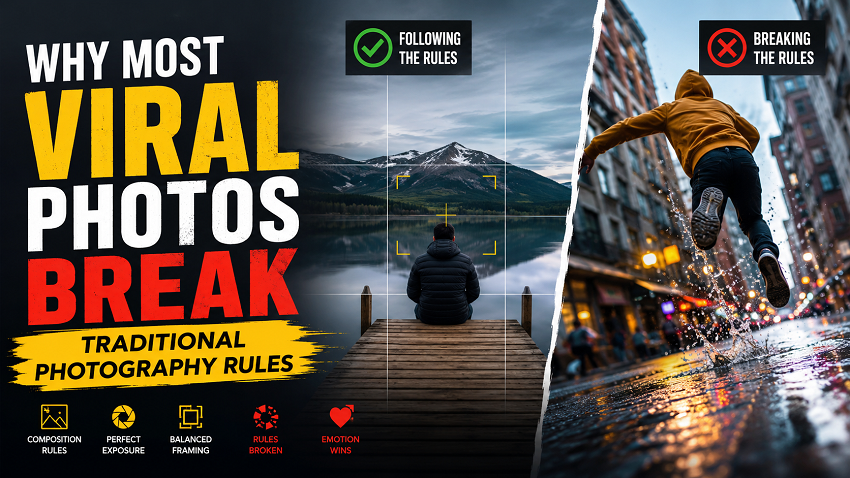
Why Most Viral Photos Break Traditional Photography Rules
In the early days of photography, the definition of a “great photo” was simple. Sharp focus, balanced composition, perfect lighting, accurate colors, and clean framing were considered the gold standard. Photographers spent years mastering technical precision because traditional photography rewarded perfection.
But the internet changed photography forever.
Today, many of the world’s most viral photos break nearly every traditional photography rule. Some are blurry. Some are poorly framed. Others contain harsh shadows, visible grain, cropped subjects, motion streaks, or imperfect lighting. Yet these same images dominate social media, gain millions of views, and create stronger emotional reactions than technically flawless photographs.
This shift reveals something important about modern visual culture: people are no longer searching only for perfect images. They are searching for emotion, authenticity, atmosphere, and human connection.
The modern audience does not always stop for perfection.
They stop for feeling.
The Problem With “Perfect” Photography
For years, photography education focused heavily on technical rules:
- Rule of thirds
- Proper exposure
- Straight horizons
- Sharp focus
- Symmetrical balance
- Controlled lighting
- Clean compositions
These principles still matter. They help photographers understand structure, visual balance, and storytelling fundamentals.
However, social media platforms changed how people consume images. Instead of studying photos carefully in magazines or galleries, users now scroll through hundreds of visuals every minute. In this environment, technically perfect images often become predictable.
The human brain quickly ignores visuals that feel too familiar.
A perfectly polished image may look impressive, but it does not always create curiosity. It does not always create emotional tension. And without emotional reaction, viewers continue scrolling.
That is why many viral photos succeed because they feel unexpected rather than perfect.
Viral Photography Is Built on Emotion
The most successful photos online usually trigger an emotional response within seconds.
People engage with images that make them:
- feel nostalgia
- experience curiosity
- sense vulnerability
- imagine a story
- feel tension
- recognize authenticity
- connect emotionally
This is why emotionally powerful photos often outperform technically perfect images.
A slightly blurry image of a real human moment can feel more meaningful than a perfectly edited studio portrait. Audiences are increasingly drawn toward visuals that appear honest rather than manufactured.
Modern photography is becoming less about technical perfection and more about psychological connection.
Why Imperfect Photos Feel More Real
One major reason viral photos break photography rules is because imperfections create realism.
In real life:
- movement exists
- lighting changes constantly
- emotions happen quickly
- people are imperfect
- environments are messy
When photography becomes too polished, it can begin to feel artificial. Audiences subconsciously recognize this.
That is why candid photography has become so powerful online. Real laughter, imperfect expressions, natural movement, and uncontrolled moments create emotional authenticity that viewers trust.
People no longer want every image to look like an advertisement.
They want photos that feel human.
Motion Blur Creates Energy
Traditional photography often treats blur as a mistake. Sharpness has long been considered a sign of technical quality.
But modern viral photography frequently uses motion blur intentionally.
Why?
Because motion creates life.
A running subject, moving lights, blurred hands, or shifting environments can make viewers feel present inside the moment. Motion blur adds:
- energy
- urgency
- realism
- emotion
- atmosphere
Perfect sharpness can sometimes feel emotionally distant. Slight movement often creates a cinematic feeling that static perfection cannot achieve.
This is one reason why many street photographers and content creators intentionally leave movement inside their photos instead of removing it.
Cropping Rules Are Changing
Traditional composition teaches photographers to avoid awkward cropping. Subjects were expected to fit perfectly inside the frame.
Modern visual storytelling often does the opposite.
Today’s viral photography frequently includes:
- partially hidden faces
- cropped bodies
- off-center framing
- objects blocking the subject
- unusual perspectives
These choices create curiosity.
When viewers cannot immediately see everything, the brain becomes more engaged. The image feels less staged and more observational, almost like a real memory captured naturally.
This psychological curiosity increases attention time, which is one reason unconventional framing performs so well online.
Why Grain and Noise Became Popular Again
For years, photographers tried removing every trace of noise and grain from their images. Smoothness became associated with professionalism.
Now grain is returning across photography, cinema, fashion campaigns, and social media aesthetics.
Why?
Because grain feels emotional.
Film texture creates:
- nostalgia
- warmth
- atmosphere
- realism
- imperfection
In a digital world filled with ultra-sharp AI-generated visuals, natural imperfections suddenly feel more trustworthy and human.
Many creators now intentionally add grain because audiences emotionally connect with texture and visual depth.
What was once considered a flaw has become an artistic tool.
The Influence of Social Media
Social media platforms dramatically changed photography priorities.
Algorithms reward content that:
- captures attention quickly
- creates emotional reaction
- encourages shares
- increases watch time
- feels relatable
- tells a story instantly
This environment pushed photography toward emotional storytelling rather than technical perfection alone.
A perfectly composed image may receive appreciation from photographers, but emotionally charged visuals often receive stronger engagement from general audiences.
This explains why spontaneous smartphone photos sometimes outperform expensive professional camera work online.
Emotion travels faster than perfection.
Why Authenticity Matters More Than Ever
Modern audiences are becoming increasingly sensitive to overedited visuals.
For years, social media encouraged:
- unrealistic beauty standards
- excessive retouching
- artificial perfection
- heavily filtered lifestyles
Eventually viewers became exhausted by visuals that felt fake.
Today, authenticity has become more valuable than perfection.
People respond more strongly to:
- natural skin texture
- honest emotions
- imperfect lighting
- documentary-style photography
- candid interactions
- realistic moments
This shift represents a major cultural change in photography.
The audience no longer wants only polished beauty.
They want emotional truth.
Cinematic Photography Changed Audience Expectations
Cinema has heavily influenced modern photography trends.
Many viral images now resemble movie scenes rather than traditional photographs. Cinematic photography often includes:
- deep shadows
- dramatic lighting
- atmospheric colors
- emotional tension
- movement
- negative space
- visual storytelling
These elements create mood instead of perfection.
Cinematic images make viewers feel something beyond simple visual admiration. They create emotional immersion.
This is one reason why cinematic photography styles continue growing across Instagram, Pinterest, and creator culture.
People remember feelings more than technical details.
Breaking Rules Requires Understanding Them First
There is an important difference between intentional rule-breaking and poor photography.
Professional photographers understand composition deeply before choosing to break traditional rules. They know:
- when imbalance creates tension
- when blur adds emotion
- when shadows improve atmosphere
- when negative space strengthens storytelling
Random mistakes rarely create strong photography.
Intentional imperfection does.
The best photographers use traditional rules as tools, not restrictions. They understand that rules are guidelines designed to improve communication, but emotional storytelling sometimes requires flexibility.
True creativity often begins after mastering the fundamentals.
Why Human Photography Still Matters in the AI Era
Artificial intelligence can now generate flawless images within seconds. AI tools can create perfect lighting, perfect skin, perfect colors, and technically perfect compositions almost instantly.
But something is still missing.
Human emotion.
Viewers increasingly recognize when an image feels emotionally empty, even if it looks visually impressive. Human photography contains subtle imperfections, observations, timing, and emotional nuance that algorithms still struggle to replicate authentically.
As AI-generated content becomes more common, genuine human perspective may become even more valuable.
The future of photography will not belong only to those who create perfect images.
It will belong to those who create emotional connection.
How to Create More Powerful Photos
If you want your photography to connect more deeply with modern audiences, focus on emotional storytelling instead of chasing perfection alone.
Observe Real Emotion
Pay attention to genuine expressions and natural interactions.
Stop Overediting
Heavy retouching can remove realism and emotional depth.
Use Imperfections Intentionally
Motion blur, grain, shadows, and asymmetry can strengthen atmosphere.
Think Like a Storyteller
Ask yourself:
“What feeling does this image create?”
Experiment More
Try unconventional angles, unusual crops, reflections, and cinematic lighting.
Capture Moments Instead of Poses
Real moments usually feel stronger than forced perfection.
Focus on Mood
Atmosphere often matters more than technical accuracy.
The Future of Viral Photography
Photography is entering a new creative era.
The internet no longer rewards only technical perfection. It rewards:
- authenticity
- emotional storytelling
- realism
- atmosphere
- individuality
- human connection
The most powerful photos today are not always the cleanest or most technically perfect.
They are the ones that make people pause.
The ones that create feeling.
The ones that feel real.
As visual culture continues evolving, photographers who understand emotion, psychology, and storytelling will stand out far more than those focused only on perfection.
Because in modern photography, connection matters more than flawless technique.
For creators, photographers, and editors exploring modern visual storytelling, cinematic aesthetics, and evolving editing styles, platforms like Photo Editing Services Company continue to showcase insights and creative approaches shaping the future of photography.
