
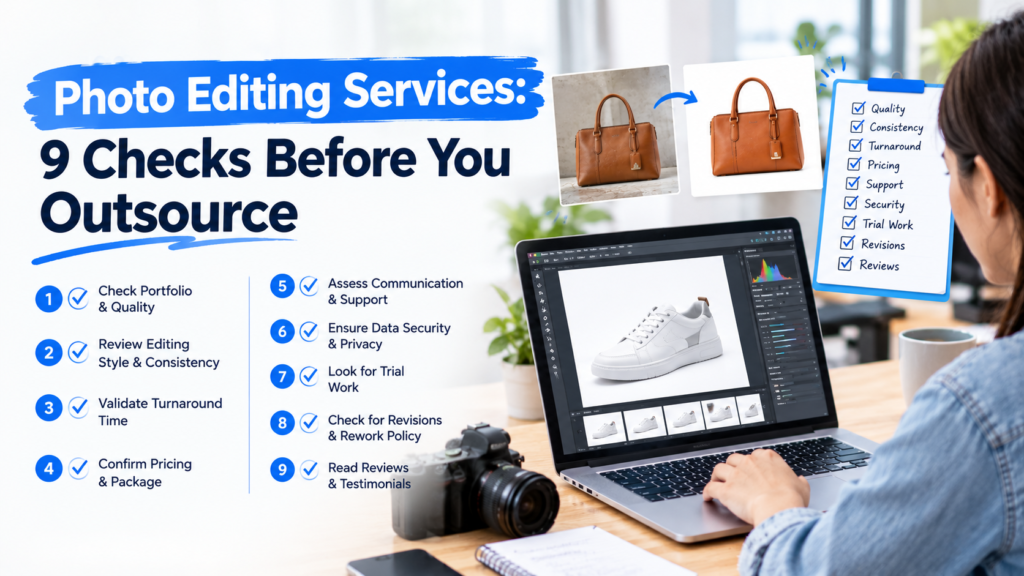
Photo Editing Services: 9 Checks Before You Outsource
An edited photograph can look impressive on its own and still be wrong for your business.
The product colour may have changed. A portrait may look overly smooth. A set of property photographs may have different brightness levels from room to room. Your team then spends another afternoon requesting corrections instead of publishing the images.
Choosing photo editing services means deciding who can understand your requirements and deliver usable files consistently.
Start by reviewing relevant before-and-after work, testing a small batch and agreeing on the editing scope, price, deadline and revision process. These checks give you a clearer basis for choosing a provider than a polished portfolio or an attractive starting rate alone.
If you are deciding how to choose photo editing services for your business, work through these nine checks before committing your next project.
1. Look for samples that match your actual work
A strong portfolio should show the type of work you need.
A beautifully retouched portrait does not demonstrate how an editor will handle a transparent bottle. A clean product cutout tells you little about balancing the lighting across a property interior.
Start with examples that resemble your subjects, materials and intended use. Examine the original and edited versions together.
Look for specific decisions:
- Were fine edges preserved?
- Does the subject retain its original shape and detail?
- Is the result appropriate for a catalogue, listing, client gallery or campaign?
- Does the editing style match what you want?
You can review the PhotoEditingServicesCompany portfolio as a starting point. Then request an assessment using your own representative files.
A portfolio helps you shortlist a provider. Your own images help you evaluate the fit.
2. Identify the problem before choosing the service
“Improve these photos” is an incomplete instruction.
Describe what prevents each image from being ready to use. Perhaps the background is distracting, the framing changes between products or the colour differs across several photographs of the same item.
For example:
- A product catalogue may need consistent cropping and background treatment.
- A portrait project may need temporary blemishes removed while preserving skin texture.
- A property gallery may need balanced exposure and straight vertical lines.
- A damaged photograph may need restoration, with reconstructed areas discussed beforehand.
This makes it easier to separate essential corrections from optional creative changes.
Also consider whether editing is the right solution. An unreadable label, hidden product detail or badly missed focus may justify another photograph. Ask the provider to identify source limitations before promising a finished result.
3. Evaluate a small batch, not just one attractive image
One successful edit does not answer every question about a larger order.
Send a small selection that represents the real assignment. Include a routine image, a difficult image and several related images that should look consistent together.
For example, a product photography test could include three views of the same bag. The important question is whether its material, colour and proportions remain consistent across all three views.
Review the sample both individually and as a group.
Check whether:
- Related images share the intended brightness and colour treatment.
- Product scale and spacing are consistent where required.
- Difficult edges receive the same care as simple ones.
- The provider follows your instructions across the batch.
- Feedback on one image is applied to other affected files.
Agree on whether the sample is paid or free and what it includes. The purpose is to evaluate the working relationship before expanding the order.
4. Set clear boundaries for retouching
Different clients can mean very different things by “natural,” “clean” or “premium.”
Provide an approved reference and explain what can change. Then identify what must remain accurate.
For product photography, that might include packaging text, material texture, stitching and the accessories supplied with the item. For portraits, it might include facial features, permanent marks and the person’s preferred level of retouching.
For property marketing, distinguish corrections to the photograph from changes to the depicted property. Discuss how any virtual staging or other material alteration will be identified wherever the image is published.
An instruction such as “remove temporary lint but preserve the fabric weave and garment construction” gives the editor a useful boundary.
Keep these decisions in a short written brief. The approved sample should become the visual reference for the remaining work.
5. Compare quotes against the same scope
Two providers can quote different prices because they are pricing different work.
One quote may include only background removal. Another may include retouching, colour adjustments, shadows and several output versions.
Before comparing costs, ask each provider to quote the same sample images and written instructions.
Confirm:
- The number of source images included.
- The editing tasks covered.
- Whether complex images cost more.
- The number and format of finished files.
- Any additional charge for urgent work.
- How revisions and changes to the brief are priced.
Keep your internal work in the comparison too. Files that need renaming, recropping or repeated corrections still require your team’s time.
The photo editing services pricing page provides a starting point for discussing costs. Request a project-specific quote using representative images and the full scope.
6. Check what the delivery deadline actually covers
A turnaround estimate needs a clear starting point and a clear deliverable.
Does the clock start when you upload the files, approve the sample or confirm the order? Does the deadline cover the first batch, all edited images or the final corrected delivery?
These details matter when images are tied to a product launch, listing date or client handover.
Tell the provider:
- When the complete source files will be available.
- Which images are the highest priority.
- When your team can review a sample.
- The final delivery date and time zone.
- Whether delivery in stages would help.
Leave room for review where the schedule allows. A project delivered immediately before publication gives you little time to resolve a misunderstood instruction.
For international projects, write the date and time zone explicitly rather than relying on “tomorrow morning.”
7. Understand how feedback and revisions work
The sample stage should test communication as well as editing quality.
Send one clear piece of feedback and check how the provider responds. Do they understand the issue? Do they ask a useful question when necessary? Does the revised file address the instruction?
Before starting a larger order, agree on the distinction between a correction and a new request.
A correction brings the image into line with the approved brief. A new request changes the brief, such as replacing an approved background or asking for an additional creative version.
Use filenames and precise comments when requesting revisions:
“BAG-014-side: preserve the original seam detail and match the crop to the approved front view.”
That instruction is easier to apply than “make the whole batch better.”
Choose one person to consolidate feedback so the editing team receives a clear set of decisions.
8. Clarify file access and confidentiality
Image projects may include unreleased products, client portraits or campaign material that is not ready for publication.
Before sharing files, ask how they will be transferred, who can access them and how long they will be retained.
Discuss whether the provider uses subcontractors or external AI services and whether those practices fit your requirements.
Also clarify whether any images may be used in the provider’s portfolio. Permission to edit your photographs should not leave either party uncertain about permission to display them publicly.
Keep your own original files and agreed project instructions. Share the material needed for the assignment through an agreed transfer method.
If you need a confidentiality agreement, raise that requirement before uploading sensitive images.
9. Agree on quality checks and the final handoff
A project is not complete merely because the download link works.
The files also need to fit the job they were commissioned for.
Ask what the provider checks before delivery, who handles questions and how corrected versions are identified.
Your acceptance checklist can include:
- Visual quality: No obvious edge errors, unwanted marks or distracting inconsistencies.
- Accuracy: Important product, person or property details remain faithful to the agreed brief.
- Consistency: Related images follow the approved style.
- Technical output: Dimensions, formats and any required transparency match the specification.
- Organisation: Filenames and folders make it easy to identify the correct image.
- Completeness: All agreed views and output versions are present.
Preview the images in their intended setting as well as at close zoom. A file may look good in an editing window but feel poorly framed in the actual website gallery.
Approve the handoff process before the order grows into recurring work.
A short brief to send with your sample images
You do not need a lengthy document to start a useful conversation. Send the following information with your enquiry:
Project: What the images will be used for.
Volume: Initial image count and expected recurring work.
Main problems: The corrections required.
Reference: An approved image or example of the desired finish.
Preserve: Details that must not be changed.
Deliverables: Required formats, dimensions, versions and filenames.
Timing: Sample deadline, final deadline and time zone.
Approval: The person responsible for reviewing the work.
This gives the provider a practical basis for assessing the files, identifying questions and preparing a relevant quote.
Frequently asked questions about photo editing services
What do professional photo editing services include?
The scope depends on the project. It may include exposure and colour adjustments, cropping, background work, retouching or restoration. Ask for an itemised scope so you know which corrections and final files are included.
How much do photo editing services cost?
Pricing depends on the complexity of the images, required edits, quantity, output versions and delivery schedule. Compare quotes based on the same source files and instructions. A starting price alone does not describe the cost of every image in your project.
Can an editing provider match my existing style?
An approved reference and clear instructions provide a useful starting point. Test the match with your own images before approving a full batch. Review a group of related photographs to check consistency across the work.
What should I send before requesting a quote?
Send representative images, the approximate quantity, required edits, output specifications and deadline. Include difficult images as well as simple ones so the provider can assess the actual scope.
Discuss your photo editing project with PhotoEditingServicesCompany
If your team is spending too much time correcting images after delivery, start by making the requirements and approval process clear.
PhotoEditingServicesCo provides professional photo editing services for photographers and businesses, including product and portrait retouching, real estate editing, clipping paths, masking and restoration. Its published workflow includes editing, quality-control review and file delivery.
Share a few representative images, your preferred finish, expected volume and deadline. Ask the team to assess the work and confirm the scope, sample arrangements, pricing and delivery schedule.
Request a photo editing quote and use your own images to establish what a successful result should look like.
